
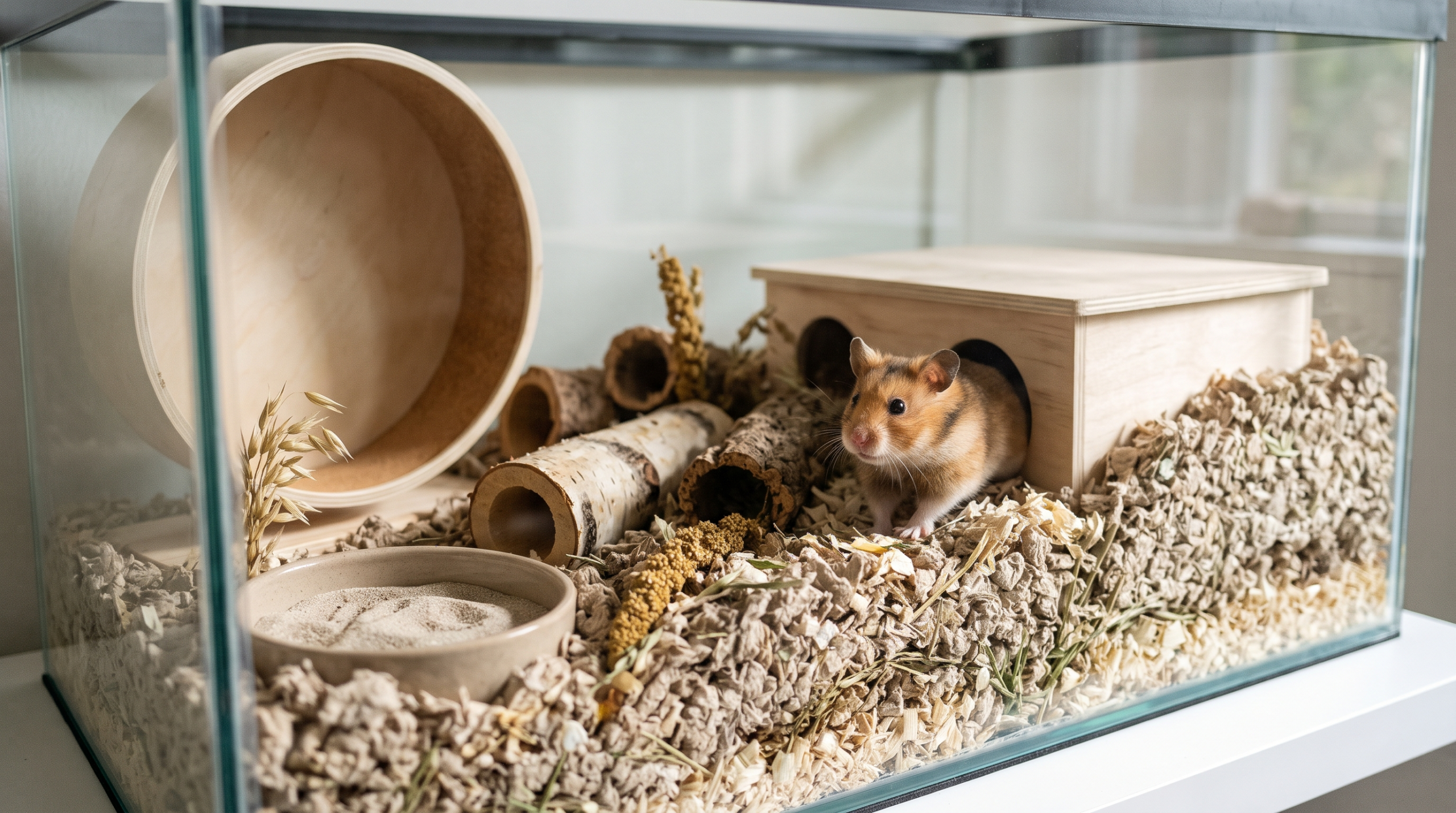
Setting up a hamster's home is one of the most important parts of preparing for this small pet. Although hamsters are relatively small animals, they need considerably more than a compact cage with a wheel and a sleeping area. Their enclosure should provide enough room to move, dig, hide, forage and explore throughout the day and night.
Hamsters are natural burrowers. In the wild, they create underground tunnels and nesting chambers, search for food and use sheltered spaces to rest. A suitable home environment should allow them to express these behaviours safely. An enclosure that looks attractive but has shallow bedding, limited floor space or too few hiding places may not meet those needs.
Choosing the right enclosure is only the beginning. Bedding depth, material, wheel dimensions, ventilation, cleaning and the arrangement of accessories all contribute to a functional habitat. This guide explains how to plan a hamster cage setup using established animal-welfare and veterinary recommendations.
Table of Contents
- How Much Space Does a Hamster Need?
- Choosing the Right Hamster Enclosure
- Choosing the Best Bedding for Hamsters
- Hiding Places, Nest Boxes and Tunnels
- Choosing the Right Hamster Exercise Wheel
- Hamster Enrichment: Toys, Chewing and Foraging
- Food and Water Placement
- Where Should You Place a Hamster Cage?
- How to Arrange a Hamster Cage
- Cleaning and Maintaining the Enclosure
- Common Hamster Cage Setup Mistakes
- Frequently Asked Questions
- Veterinary and Animal-Welfare References
- Conclusion
How Much Space Does a Hamster Need?
Floor space is one of the most important considerations when choosing a hamster enclosure. A larger usable area gives a hamster more room to explore, exercise, forage and move between different parts of its habitat. It also makes it easier to provide deep bedding, a suitable wheel, hiding places and other enrichment without filling every available space.
Several established animal-welfare organisations recommend an enclosure with a floor area of at least 100 cm by 50 cm. The PDSA hamster-care guidance refers to this footprint, while Blue Cross also recommends a minimum floor area of 100 cm by 50 cm and a height of at least 50 cm.
Woodgreen provides species-related enclosure dimensions and recommends a large, well-designed habitat with enough depth for burrowing. Its guidance distinguishes between the needs of Syrian and Chinese hamsters and those of smaller dwarf species. Larger enclosures are preferable where practical, provided they remain secure and appropriately arranged.
Hamster Enclosure Size Recommendations
| Organisation | Published Guidance | Practical Meaning |
|---|---|---|
| PDSA | At least 100 × 50 cm floor area. | A useful minimum footprint when planning a hamster habitat. |
| Blue Cross | At least 100 × 50 cm floor area and 50 cm in height. | Provides room for accessories and a substantial bedding layer. |
| Woodgreen | 100 × 50 cm footprint, with height recommendations that vary by hamster type. | Highlights the importance of usable floor space and sufficient enclosure depth. |
| RSPCA | Emphasises secure housing, deep bedding and opportunities for natural behaviour rather than giving a single minimum measurement on its general housing page. | Space should be considered alongside the quality and arrangement of the habitat. |
These recommendations are not identical, so it is useful to consider both the enclosure footprint and its internal design. A tall enclosure with very little floor space is not automatically suitable simply because it has extra height. Hamsters need a broad, continuous floor area that can accommodate their essential resources.
Does Hamster Species Affect Enclosure Requirements?
Syrian hamsters are larger than dwarf hamsters and need equipment sized for their bodies. Chinese hamsters also have different proportions from Syrian hamsters. However, a smaller hamster should not automatically be housed in a tiny enclosure. Dwarf hamsters also benefit from generous floor space, deep bedding and opportunities to explore.
Bar spacing is another consideration when choosing a barred enclosure. Woodgreen's guidance gives different spacing recommendations for different hamster types, including approximately 1 cm for Syrian and Chinese hamsters and 7 mm for dwarf and Roborovski hamsters. The enclosure must prevent the individual animal from squeezing through gaps or becoming trapped.
Choosing the Right Hamster Enclosure
The best enclosure is one that provides enough usable floor space, allows a deep bedding layer, has secure ventilation and makes it possible to arrange accessories safely. Different enclosure styles can meet these requirements when they are designed and maintained properly.
Glass Tanks and Terrariums
A suitably sized glass tank or terrarium can provide a broad, uninterrupted floor area and enough depth for substantial bedding. Solid sides also help contain loose bedding and reduce the amount scattered outside the enclosure.
Ventilation is essential. A glass enclosure should have a secure, well-ventilated mesh lid rather than an airtight cover. The lid must prevent escapes while allowing adequate airflow. Check that the mesh is secure and that there are no gaps around the edges.
Barred Hamster Cages
Some barred cages provide good ventilation and convenient access for cleaning. However, not every commercially available cage has enough floor space or a suitable base for deep bedding. Bar spacing must also be appropriate for the hamster's size.
A cage with a shallow plastic base may make burrowing difficult if bedding spills through the bars or cannot be piled deeply enough. Avoid designs that force the hamster to live primarily on wire flooring. The main living area should have a solid floor covered with appropriate bedding.
DIY and Modified Enclosures
A properly constructed DIY enclosure can offer generous floor space and flexibility. However, it must be made from safe, durable materials and designed to prevent escapes. Ventilation, secure joins, appropriate access points and protection against chewing or damage all need attention.
Any modified storage container or homemade habitat should be checked carefully for sharp edges, weak joints, unsuitable plastic and inadequate airflow. A large container is not automatically a safe enclosure simply because it has plenty of space.
Features to Check Before Buying
- Floor area: Check the actual usable internal dimensions rather than relying only on the product's external measurements.
- Solid base: The main living surface should be solid and suitable for bedding.
- Ventilation: Ensure the enclosure allows adequate airflow without creating an exposed or insecure opening.
- Secure lid: The top should remain firmly in place and prevent escapes.
- Bedding depth: There should be enough room to provide deep bedding without blocking ventilation.
- Access: Doors or removable lids should make routine cleaning and maintenance manageable.
- Safe construction: Avoid sharp edges, unstable platforms and gaps that could trap a hamster.
Choosing the Best Bedding for Hamsters
Bedding is not simply a soft material placed at the bottom of a cage. It is an important part of a hamster's habitat because it allows the animal to dig, create tunnels, build a nest and rest in a sheltered space.
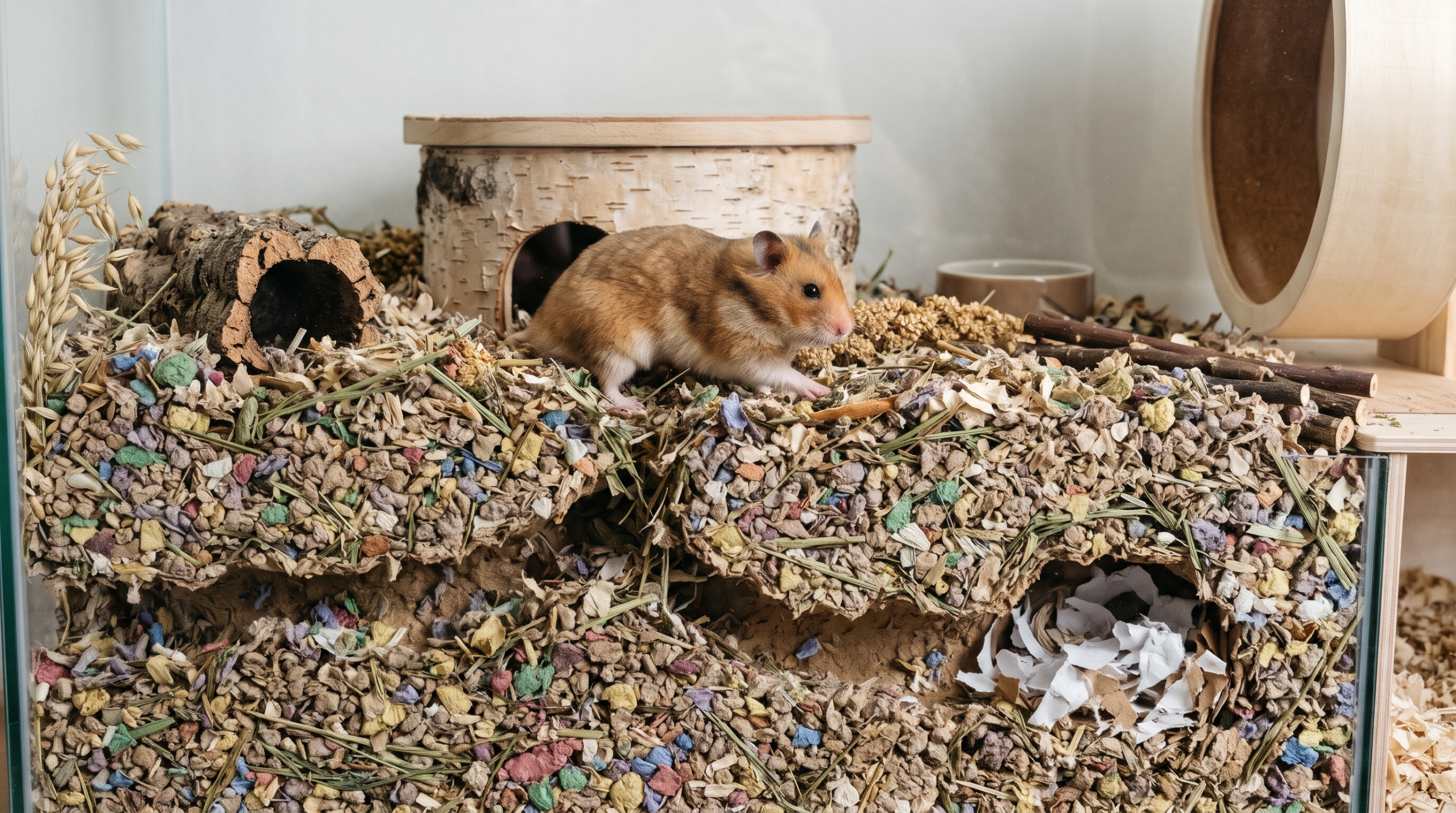
Hamsters naturally spend time underground in burrows. A thin layer of bedding may absorb waste, but it does not provide the depth needed for meaningful burrowing. Providing a deep layer that can hold its shape gives the hamster more opportunities to display natural digging behaviour.
How Deep Should Hamster Bedding Be?
Animal-welfare organisations publish slightly different bedding-depth recommendations. The PDSA advises providing at least 25 cm of bedding, while Blue Cross recommends at least 20 cm. Woodgreen recommends a substantial bedding layer across most of the enclosure, with a deeper digging area that can reach approximately 25–30 cm.
| Organisation | Bedding Guidance | What It Supports |
|---|---|---|
| PDSA | At least 25 cm. | Digging, burrowing and nesting behaviour. |
| Blue Cross | At least 20 cm. | A deeper substrate for natural activity. |
| Woodgreen | At least 15 cm across much of the enclosure, with a deeper digging area of approximately 25–30 cm. | Allows a deeper burrowing zone within the habitat. |
These figures provide useful guidance, but the bedding must also be suitable for burrowing. A deep layer of material that collapses immediately may not hold tunnels effectively. Paper-based bedding can be arranged and lightly compressed to help create a more stable substrate. Mixing suitable materials may also improve structure.
Which Bedding Materials Are Suitable?
Paper-based bedding is a commonly recommended option because it can be soft, absorbent and suitable for burrowing when prepared properly. Choose a product designed for small animals that is low in dust and free from added fragrances.
Other materials may also be suitable depending on their processing and the guidance being followed. PDSA lists dust-free aspen, spruce and hemp among possible bedding materials. Blue Cross also discusses paper, wood-pulp and hemp-based options, while emphasising the need to avoid unsuitable dusty materials.
- Paper-based bedding: A soft, absorbent option that can be used to create a deep burrowing layer.
- Dust-extracted aspen: Can be used as part of a suitable bedding arrangement when it is specifically prepared for small animals and is low in dust.
- Hemp bedding: Another option identified by some animal-care organisations. Check its texture and dust level before use.
- Soft hay: Can be mixed in small amounts with suitable bedding to help add structure, depending on the product and the hamster's response.
- Unscented toilet paper: Plain, unscented toilet paper can be provided as nesting material.
Which Bedding Materials Should Be Avoided?
Avoid materials that are dusty, strongly scented or likely to cause problems if chewed or swallowed. Cotton wool, fluffy nesting material and synthetic fibres can be particularly hazardous because they may wrap around limbs or cause digestive problems if ingested.
- Cotton wool and fluffy nesting products: Fibres can become tangled around limbs or create an ingestion risk.
- Sawdust and dusty shavings: Fine dust can irritate the respiratory system and eyes.
- Scented bedding: Added perfumes can be unpleasant for animals with sensitive senses.
- Unsuitable wood shavings: Not all wood products are processed or prepared in the same way. Follow reputable animal-care guidance and avoid materials that are dusty or unsuitable for small pets.
- Shredded glossy or heavily printed paper: Avoid paper products with coatings, inks or finishes that are not intended for animal bedding.
Hiding Places, Nest Boxes and Tunnels
Hiding places give hamsters somewhere to retreat, rest and feel protected. In a natural environment, burrows and sheltered spaces provide protection from exposure and allow the animal to rest away from open surroundings.
A well-arranged enclosure should include several sheltered areas rather than relying on one small plastic hideout. Different hideouts can create separate resting spaces and make the habitat more interesting to explore.
Choosing a Suitable Hideout
Wooden, ceramic and other appropriately made hideouts can provide useful sheltered spaces. Choose a design with enough internal room for the hamster to enter, turn around and rest comfortably. Check that openings are large enough and that the hideout has no sharp edges or unstable parts.
Multi-chamber hideouts can provide separate areas for nesting and resting. A hideout with more than one entrance may also give the hamster additional ways to move around its habitat. However, the enclosure should still include enough open space for normal movement.
Cardboard Tunnels and Natural Hiding Areas
Plain cardboard tubes and tunnels can provide additional routes through the enclosure. They can be arranged partly beneath bedding or placed between different habitat zones. Make sure openings are wide enough for the hamster and that the structure cannot collapse or trap it.
Untreated wooden tunnels, cork pieces and other suitable natural accessories can add variety. Inspect them regularly for damage, sharp edges or excessive chewing that could make them unsafe.
Why Multiple Hiding Places Matter
Several hiding areas allow a hamster to choose where it wants to rest or explore. They can also make the enclosure feel less exposed. Place hides in different areas while keeping routes between them clear.
A predictable, comfortable environment can also help a hamster become more familiar with its surroundings. For practical advice on building trust gradually, read PetStory's guide on how to bond with a hamster.
Choosing the Right Hamster Exercise Wheel
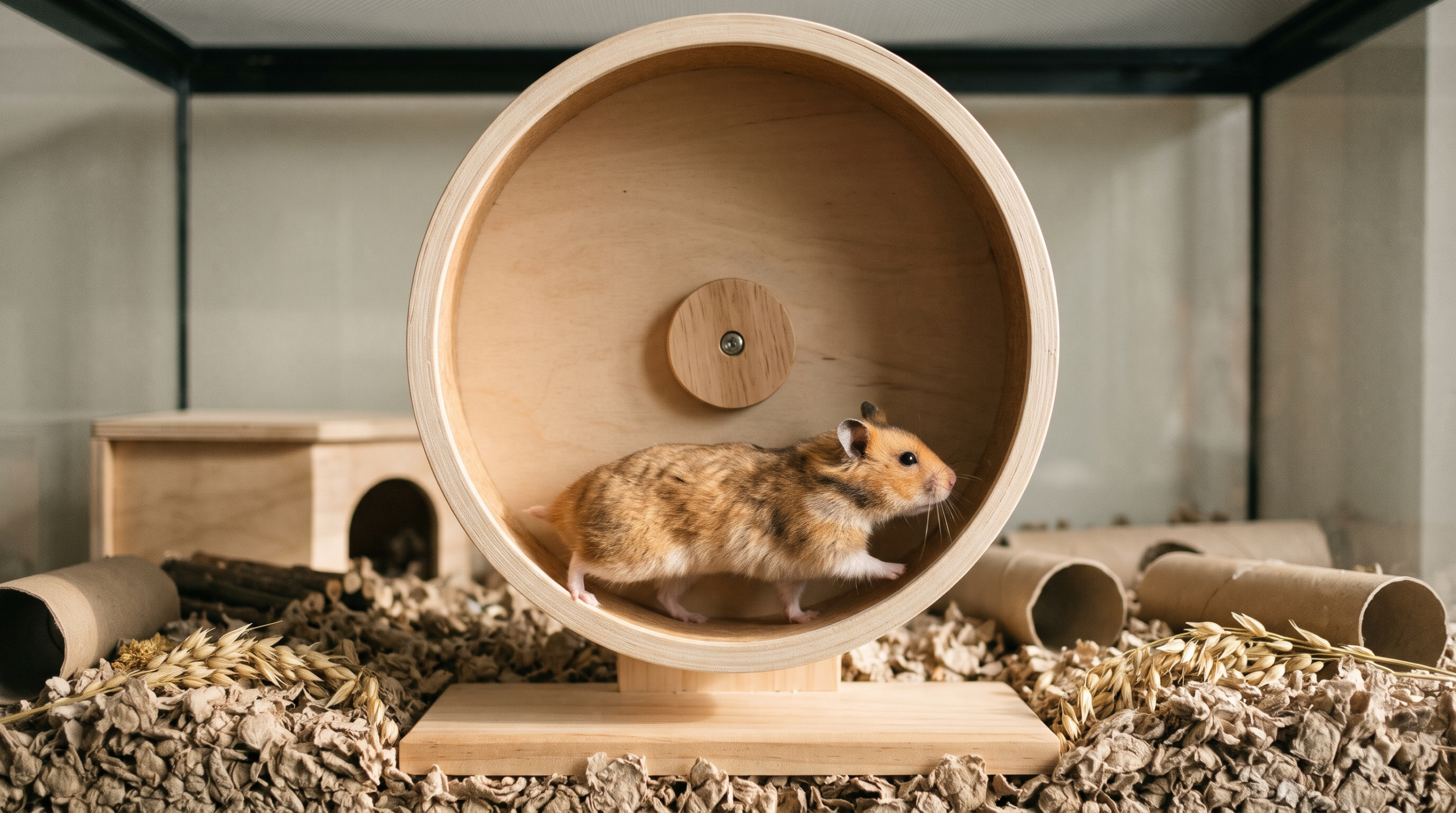
An exercise wheel provides an opportunity for hamsters to run inside their enclosure. However, choosing a wheel based only on its appearance or the size of the cage can lead to a poor fit. The wheel must be large enough for the hamster to run with a natural body position.
A wheel that is too small may force the hamster to arch its back while running. Over time, this can place unnecessary strain on its body. A suitable wheel should allow the animal to run with a relatively straight back and without its head or body being forced into an awkward position.
Recommended Hamster Wheel Sizes
Published recommendations vary slightly between animal-welfare organisations. The following comparison shows the sizes given in their guidance. Always consider the individual hamster's posture and comfort when choosing a wheel.
| Hamster Type | Published Wheel Guidance | Important Consideration |
|---|---|---|
| Syrian hamster | Blue Cross: approximately 27–32 cm. PDSA: at least 30 cm. Woodgreen: approximately 12 inches. | Choose a large wheel that allows a straight running posture. |
| Campbell's and Winter White dwarf hamsters | Blue Cross: approximately 22–25 cm. | Check that the hamster can run without arching its back. |
| Roborovski hamster | Blue Cross: approximately 20–22 cm. | Choose a stable wheel with a running surface appropriate for the individual. |
| Chinese hamster | Blue Cross: approximately 25–27 cm. | Check the hamster's posture and comfort while running. |
| Dwarf hamsters, general PDSA guidance | At least 20 cm. | A larger wheel may be needed depending on the hamster's size and running posture. |
These measurements are useful starting points, not a substitute for checking the fit. A wheel should remain stable during use and have a continuous running surface. Avoid wire or mesh running surfaces because they can create an injury risk to small feet.
What Makes a Wheel Suitable?
- Solid running surface: The surface should be continuous rather than made from open wire or mesh.
- Appropriate diameter: The hamster should be able to run without arching its back.
- Stable construction: The wheel should not wobble, tip or move dangerously during use.
- Safe access: The entrance and running surface should not create trapping points.
- Easy cleaning: Choose a design that can be cleaned regularly and checked for damage.
Place the wheel on a stable surface and make sure it cannot become buried or obstructed as the hamster moves bedding around. Check it regularly to ensure it still spins freely and remains secure.
Hamster Enrichment: Toys, Chewing and Foraging
Enrichment gives hamsters opportunities to explore, investigate, chew and search for food. A suitable enclosure should offer more than a wheel and a sleeping area. Different textures, tunnels, hiding places and foraging opportunities can make the habitat more engaging.
Chewing Materials
Hamsters naturally gnaw and investigate objects with their teeth. Suitable untreated wooden items and plain cardboard can provide additional opportunities for chewing and exploration. Choose products made for small animals or materials known to be safe for their use.
Inspect chew items regularly and remove anything that becomes damaged, sharp or unsafe. Avoid painted, varnished or chemically treated objects unless they are specifically confirmed as safe for small animals.
Scatter Feeding and Foraging
Instead of placing all food in one bowl, some of the hamster's normal dry food can be scattered across suitable areas of the enclosure. This encourages the animal to search and collect food, which is closer to its natural foraging behaviour.
Scatter feeding should be introduced sensibly. Keep track of the amount offered and check the hamster's food stores so that fresh food does not become hidden and spoil. A food bowl can still be provided if needed, particularly for monitoring intake or offering certain foods.
Small portions of suitable treats can also be used as occasional enrichment. Choose foods appropriate for the hamster's species and dietary needs, and keep treats moderate. PetStory's guide to safe and healthy hamster treats provides further ideas for suitable options.
Sand Baths
A suitable sand bath gives a hamster an opportunity to roll and move around in a loose substrate. Use a product specifically intended for small animals and avoid dusty powders or chinchilla dust. The container should be stable, large enough for the hamster to use and shallow enough for easy access.
Sand baths should be kept clean and checked regularly. Remove soiled material and replace the sand when necessary. Do not use scented products or materials that create airborne dust.
Safe Natural Accessories
Natural-looking accessories can add variety when selected carefully. Cork tunnels, suitable wooden branches, cardboard structures and stable platforms can provide different textures and routes through the enclosure.
Not every decorative item sold for small pets is suitable for hamsters. Check construction, material, stability and size before adding anything. Avoid overcrowding the enclosure, as the hamster still needs open areas to move freely.
Food and Water Placement
Food and water should be easy to reach and placed where they are unlikely to become buried, contaminated or knocked over. A hamster may store food in different parts of its enclosure, so it is useful to check its usual food-storage areas during routine maintenance.
Food Bowls and Feeding Areas
A small, stable ceramic bowl can be used for the hamster's main food if a bowl is part of the chosen feeding routine. Ceramic bowls are generally heavier than lightweight plastic dishes and may be less likely to tip over.
Some of the hamster's dry food can also be scattered in suitable areas to encourage foraging. Avoid placing food directly in a spot where it is likely to become wet or contaminated by the water source.
Water Bottles and Bowls
Fresh drinking water should always be available. Some owners use a suitable water bottle, while others provide a small, stable bowl. Whichever option is used, check it daily to ensure it is clean, accessible and functioning properly.
A water bottle should be securely attached and positioned at a height the hamster can reach comfortably. Check that the drinking mechanism works and is not blocked. A water bowl should be heavy enough to reduce tipping and placed where bedding is less likely to fill it.
Food and water placement should be reviewed as the hamster rearranges its bedding. A dish that was accessible during the initial setup may become buried or blocked later.
Where Should You Place a Hamster Cage?
The location of the enclosure can affect a hamster's comfort. Choose a quiet, stable area of the home where the temperature remains reasonably consistent and the enclosure is protected from direct sunlight, draughts and sudden disturbances.
Hamsters are sensitive to their surroundings and are generally most active during the evening and night, although activity patterns vary. A cage placed beside a television, loud speaker, frequently used doorway or noisy appliance may expose the animal to repeated disturbance.
Temperature and Airflow
PDSA recommends keeping hamsters in an environment around 18–21°C. The MSD Veterinary Manual gives a wider temperature range of approximately 18–26°C in its housing guidance. These recommendations are not identical, so a stable room temperature within the more conservative PDSA range is a sensible household target.
Avoid placing the enclosure next to radiators, fireplaces, air-conditioning vents or windows that receive strong direct sunlight. Sudden temperature changes and poor ventilation can create an unsuitable environment.
Noise, Light and Household Activity
Choose a location away from repeated loud noises and heavy household traffic. Avoid switching bright lights on suddenly beside the enclosure during the hamster's usual resting period. A predictable light and dark routine helps maintain a consistent environment.
The enclosure should still be placed somewhere the owner can check it easily. Daily observation is important for monitoring appetite, water intake, activity, bedding condition and general behaviour.
How to Arrange a Hamster Cage
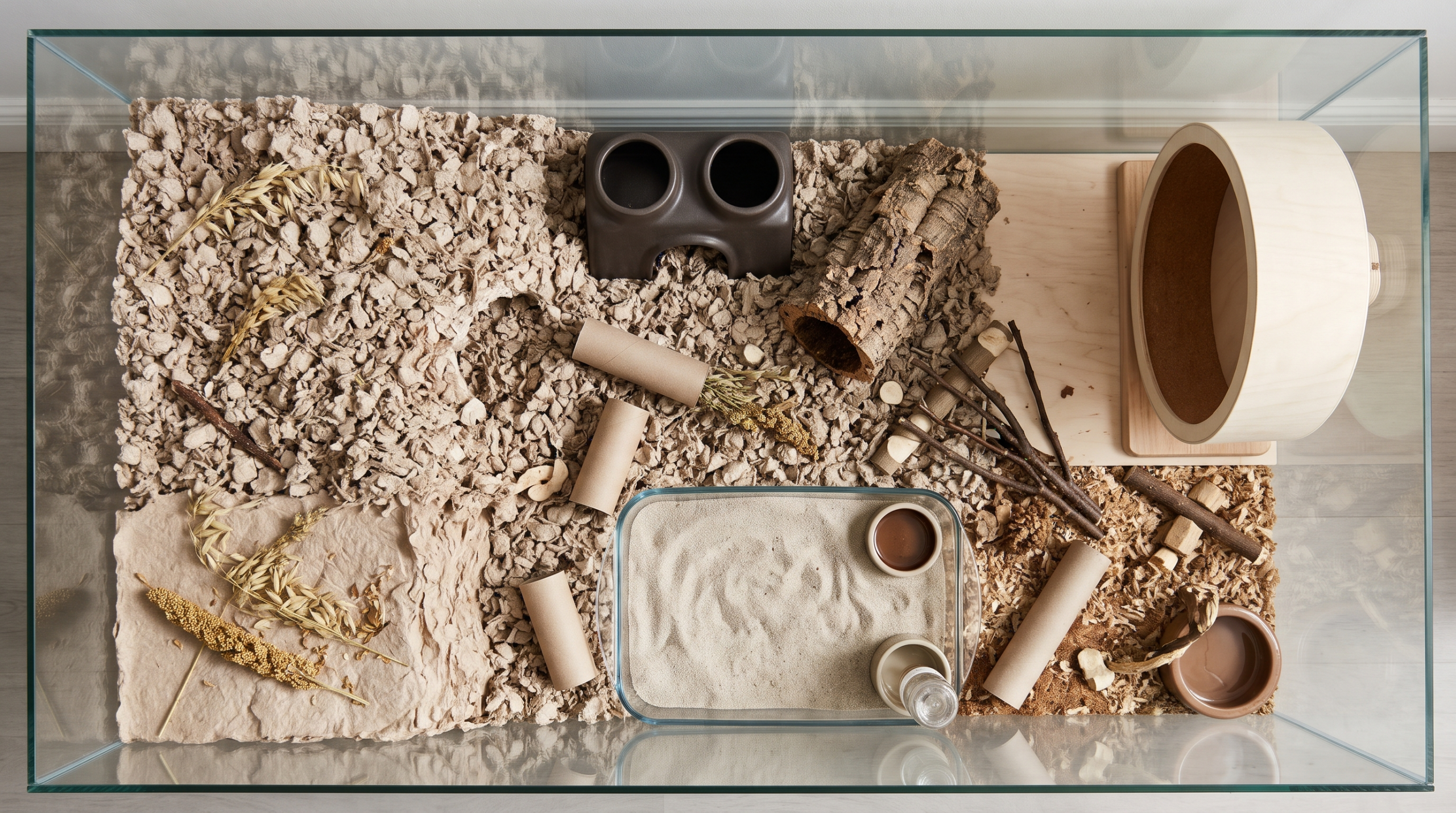
A good hamster cage layout separates the main activities without making the enclosure feel crowded. The goal is to provide distinct areas for burrowing, resting, running, bathing and feeding while preserving enough open space for the hamster to move comfortably.
For an enclosure with a 100 × 50 cm footprint, one practical arrangement is to dedicate a substantial section to deep bedding and burrowing, then position the wheel and heavier accessories on stable areas where they will not become buried or tip over.
Plan the Main Functional Areas
- Burrowing zone: Provide the deepest bedding area in a section where the hamster can dig and create tunnels.
- Resting zone: Position one or more hideouts where the hamster can retreat and build a nest.
- Exercise zone: Place the wheel on a stable, level surface with enough clearance for safe use.
- Sand-bath zone: Place a stable sand bath where it can be accessed without blocking movement.
- Feeding zone: Keep food and water accessible and away from areas where they are likely to become contaminated.
- Exploration zone: Use tunnels, safe chew items and open pathways to create variety without filling every part of the floor.
Position Heavy Accessories Carefully
Heavy ceramic hides, large wheels and other substantial accessories should be positioned so that they cannot fall into deep bedding or collapse a burrow. They should rest securely on the enclosure's solid base or on a stable support designed for that purpose.
Where bedding is deep, plan the position of heavy items before filling the enclosure. Check that the wheel remains stable and that the hamster cannot dig underneath a heavy accessory in a way that makes it unsafe. Avoid placing heavy objects on top of loose bedding where they may shift.
Leave Room for Natural Movement
It can be tempting to fill the enclosure with accessories, but too many objects can reduce the usable floor area. A practical layout balances enrichment with open pathways. The hamster should be able to move between its hideout, wheel, food and water without having to squeeze through crowded spaces.
The best layout may change as the hamster rearranges bedding or develops preferences for particular areas. Observe how the animal uses the enclosure and make careful adjustments when necessary.
Cleaning and Maintaining the Enclosure
Regular cleaning helps maintain a hygienic habitat, but cleaning too much at once can remove familiar scents and disturb the hamster's established nesting areas. A balanced routine combines daily checks, regular spot cleaning and occasional deeper cleaning based on the enclosure's size and condition.
Daily Checks
Check the hamster's food and water every day. Remove fresh food that has spoiled, inspect the water source and look for any obvious signs of damp or soiled bedding. Observe the hamster's general behaviour and make sure the wheel and other equipment remain safe and functional.
Spot Cleaning
Remove visibly soiled bedding and wet areas as needed. Many hamsters use a particular corner as a toilet, although habits differ. Check the usual toileting area and remove dirty material without unnecessarily disturbing the rest of the enclosure.
Blue Cross and the RSPCA advise spot cleaning every few days, with the exact frequency depending on the enclosure and the hamster's habits. A larger enclosure may remain clean for longer in some areas, but any wet or contaminated bedding should be removed promptly.
Deeper Cleaning
A full or deeper clean should be carried out when the enclosure needs it rather than following an inflexible schedule. Blue Cross and the RSPCA describe a deeper clean approximately once or twice a month as a general guide. The appropriate frequency depends on enclosure size, bedding depth, ventilation and how quickly the habitat becomes soiled.
During a deeper clean, move the hamster to a secure temporary enclosure. Remove dirty bedding and clean the base and accessories using a suitable, pet-safe cleaning method. Allow surfaces to dry fully before replacing bedding and returning the hamster.
Where possible, retain a portion of clean, familiar bedding and mix it into the refreshed enclosure. Blue Cross recommends keeping some of the old clean bedding during a full clean. This helps preserve familiar scents and reduces the extent of environmental change.
Check Accessories During Cleaning
- Inspect the wheel for cracks, loose parts or a running surface that has become damaged.
- Check wooden hides and tunnels for sharp edges or excessive wear.
- Wash food and water containers regularly and rinse them thoroughly.
- Remove spoiled food from storage areas.
- Check that the sand bath remains clean and free from waste.
- Make sure the enclosure lid and access points remain secure.
A clean enclosure should still retain familiar nesting material where it is safe to do so. The aim is to maintain hygiene without repeatedly stripping away every familiar scent or disrupting the hamster's resting area unnecessarily.
Common Hamster Cage Setup Mistakes
Even well-intentioned owners can choose equipment that looks convenient but does not provide a suitable environment. Understanding common mistakes before setting up the enclosure can help avoid unnecessary changes later.
Choosing an Enclosure That Is Too Small
A compact cage may be easy to place in a room, but limited floor space makes it difficult to provide a wheel, deep bedding, hides and enrichment together. Start with an appropriately sized enclosure rather than trying to compensate for a small cage by adding more accessories.
Providing Too Little Bedding
A thin bedding layer does not allow meaningful burrowing. Provide the depth recommended by reputable animal-care guidance and choose material that can support digging and nesting.
Using an Undersized Wheel
A wheel that forces the hamster to arch its back is not an appropriate fit. Choose a wheel based on the hamster's type and body size, then observe its posture while running.
Using Unsafe Nesting Materials
Fluffy cotton-like bedding and synthetic nesting fibres can become tangled around limbs or create ingestion risks. Choose suitable paper-based nesting material instead.
Overcrowding the Enclosure
Adding too many toys, decorations and accessories can reduce usable floor space. Provide a selection of useful enrichment items while leaving clear routes for movement.
Placing Heavy Items on Loose Bedding
Heavy accessories can shift or fall if they are supported only by loose bedding. Place them securely on the base or on stable supports designed for the enclosure.
Keeping the Enclosure in an Unsuitable Location
Direct sunlight, draughts, heat sources and repeated loud noises can make the enclosure uncomfortable. Choose a stable indoor location with suitable airflow and a consistent temperature.
Cleaning Too Aggressively
Removing all bedding and nesting material during every cleaning session can disrupt familiar scents. Spot clean regularly, carry out deeper cleaning when needed and retain clean familiar bedding where possible.
Frequently Asked Questions
1. What is the minimum size for a hamster cage?
PDSA and Blue Cross recommend a floor area of at least 100 × 50 cm. Blue Cross also recommends a height of at least 50 cm. A larger enclosure is preferable when practical, provided it is secure, well ventilated and arranged safely.
2. How deep should hamster bedding be?
Recommendations vary. PDSA advises at least 25 cm, while Blue Cross recommends at least 20 cm. Woodgreen recommends a substantial layer across the enclosure with a deeper digging area of approximately 25–30 cm. Choose bedding that is low in dust and can support burrowing.
3. What is the best bedding for hamsters?
Suitable paper-based bedding is a commonly recommended option. Depending on the product and the guidance followed, dust-extracted aspen, hemp and other appropriate materials may also be used. Avoid scented or dusty products and do not use cotton wool or fluffy synthetic nesting material.
4. What size wheel does a Syrian hamster need?
Published recommendations include approximately 27–32 cm from Blue Cross, at least 30 cm from PDSA and around 12 inches from Woodgreen. The wheel should have a solid running surface and allow the hamster to run without arching its back.
5. Do hamsters need a sand bath?
A suitable sand bath can provide an additional opportunity for natural grooming and activity. Use an appropriate small-animal sand product rather than dusty powder, and provide a stable container that is easy for the hamster to enter and leave.
6. How often should a hamster cage be cleaned?
Check the enclosure daily and remove wet or soiled bedding as needed. Spot cleaning is commonly recommended every few days. Deeper cleaning may be needed around once or twice a month, depending on the enclosure and how quickly it becomes dirty. Retain some clean familiar bedding when possible.
7. Where should a hamster cage be placed?
Place the enclosure in a quiet indoor location away from direct sunlight, draughts, radiators and loud appliances. PDSA recommends a temperature around 18–21°C. The enclosure should have suitable ventilation and remain easy to check every day.
8. Can hamsters live together in the same cage?
Housing recommendations depend on species, but keeping hamsters individually is the safer general approach for pet owners. Syrian and Chinese hamsters are solitary. Some dwarf hamsters may be kept in compatible same-sex groups under certain circumstances, but fighting can occur and may cause serious injuries. A shared enclosure should never be assumed to be safe simply because the animals initially appear comfortable together.
9. Do hamsters need a hiding place?
Yes. Hiding places allow hamsters to retreat, rest and build nests. Provide suitable hideouts in different parts of the enclosure, with enough room for the hamster to enter and turn around comfortably.
10. Are hamster balls recommended?
Blue Cross advises against hamster exercise balls. They can restrict access to the environment and may create safety concerns. A properly sized solid-surface wheel inside a suitable enclosure is a better way to provide an exercise opportunity.
Veterinary and Animal-Welfare References
The following organisations and veterinary resources provide further information about hamster housing, bedding, exercise, enrichment and general care. Their recommendations are not identical in every area, so the relevant guidance has been identified in the sections above.
- Blue Cross: Hamster Care — enclosure dimensions, bedding, wheel sizes, cleaning, housing and general care.
- PDSA: Hamsters as Pets — housing size, bedding depth, temperature, wheel requirements and suitable materials.
- Woodgreen: Caring for Hamsters as Pets — enclosure dimensions, bedding, burrowing, enrichment and equipment.
- RSPCA: Creating a Good Home for Hamsters — secure housing, bedding, nesting, hiding places, cleaning and environmental needs.
- MSD Veterinary Manual: Providing a Home for a Hamster — veterinary housing guidance, temperature, ventilation, bedding and enclosure design.
- NC3Rs: Housing and Husbandry for Hamsters — information on hamster behaviour, burrowing, nesting, enrichment and housing considerations. This resource is primarily intended for laboratory animal care.
Conclusion: Building a Comfortable and Enriching Hamster Home
A suitable hamster cage setup should provide enough room for the animal to move naturally, dig, hide, forage and exercise. Choosing a spacious enclosure is the foundation, but the quality of the bedding, wheel, hiding places and overall layout is equally important.
Deep, suitable bedding supports burrowing, while multiple hideouts and tunnels provide sheltered areas to explore and rest. A correctly sized solid-surface wheel offers an appropriate exercise opportunity, and carefully selected enrichment makes the enclosure more engaging without filling every available space.
Regular checks, sensible spot cleaning and a stable cage location help maintain a comfortable environment. By planning the enclosure around the hamster's needs rather than its appearance alone, owners can create a practical habitat that supports natural behaviours and everyday wellbeing.
Ready to Learn More?
Explore more practical advice in PetStory's Small Pets section, including guides to hamster bonding, nutrition, safe treats and everyday care.
Learn how to bond with a hamster and help build a calm, positive relationship with a new pet.
About the Author
Irfan Hyder is the editor of PetStory.org, an independent publication covering pet care, adoption, nutrition and behaviour. He has spent around 8 years caring for pets at home, including his Golden Retriever, Max, his Persian cat, Luna, and pet birds, and writes alongside veterinary and reputable sources.