
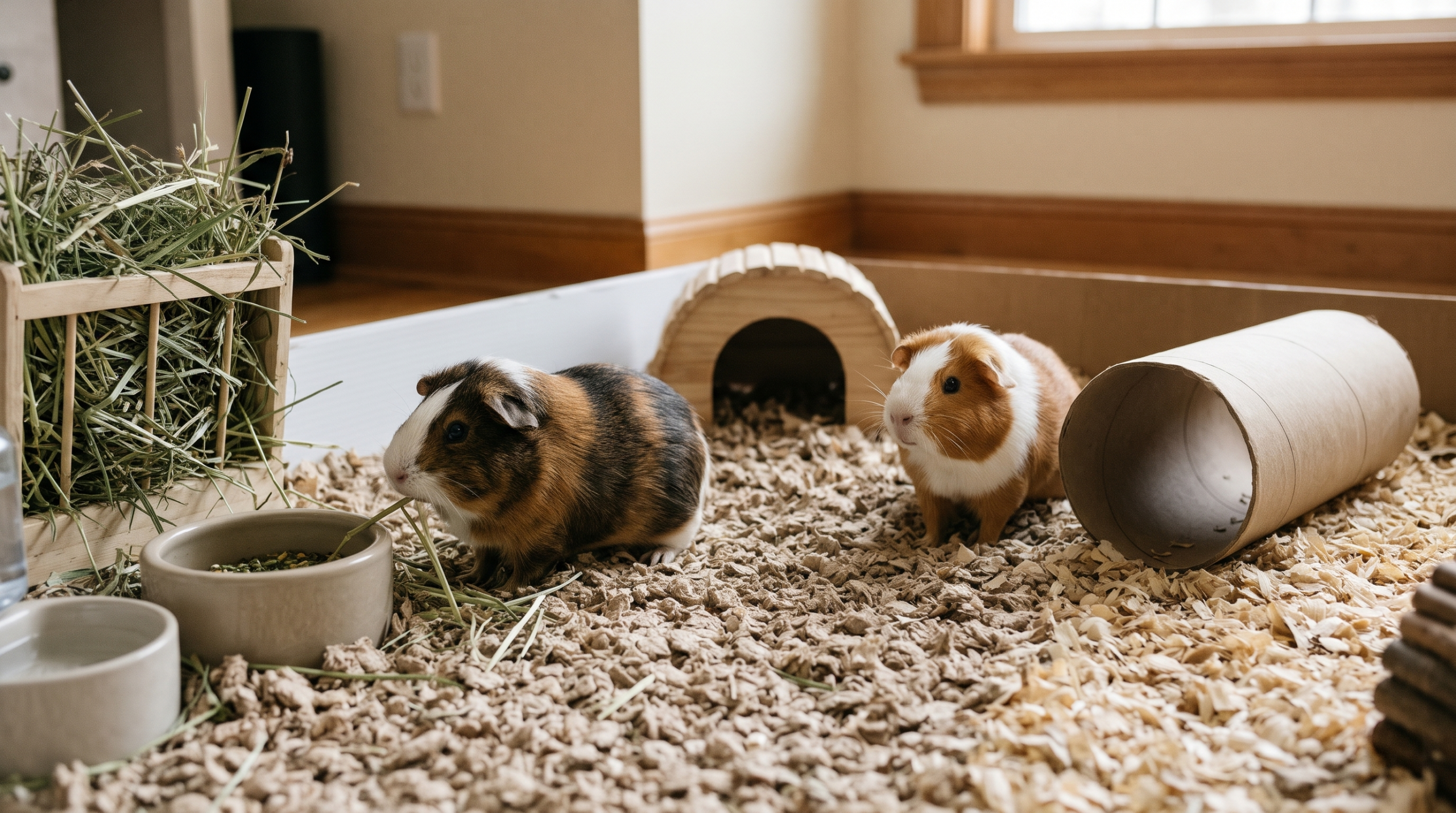
A suitable guinea pig cage setup needs more than a cage, a water bottle and a food bowl. Guinea pigs are active, social animals that need room to move, comfortable flooring, dry bedding, places to hide and opportunities to explore. Their enclosure should also be easy to clean and provide good airflow.
For first-time owners, choosing the right housing can be confusing because cage sizes and bedding recommendations differ between organisations. Some guidance focuses on indoor cages, while other recommendations describe an outdoor hutch with a separate exercise run. Understanding these differences helps owners choose an enclosure that meets their animals' needs rather than relying on a single product label or minimum measurement.
This guide explains how to plan a safe guinea pig enclosure, choose suitable bedding and arrange essential accessories for everyday comfort and activity.
Table of Contents
- How Much Space Do Guinea Pigs Need?
- Choosing the Right Guinea Pig Enclosure
- Best Bedding for Guinea Pigs
- Hiding Places, Hideouts and Tunnels
- Essential Guinea Pig Cage Accessories
- Enrichment and Exercise
- Where to Place a Guinea Pig Cage
- How to Arrange a Guinea Pig Cage
- Cleaning and Maintaining the Enclosure
- Common Guinea Pig Cage Setup Mistakes
- Frequently Asked Questions
- Veterinary and Animal-Welfare References
- Conclusion
How Much Space Do Guinea Pigs Need?
Guinea pigs need enough uninterrupted floor space to walk, run, stretch out, explore and move between their food, water and resting areas. A cage that looks large in a product photograph may still offer too little usable space once hideouts, bowls and hay stations are added.
Guinea pigs are social animals and should generally live with a compatible guinea pig companion. Housing should therefore be selected for the number of animals, not simply for one small pet. Introductions and compatibility matter, and a veterinarian or experienced rescue organisation can help if companionship creates persistent conflict.
Comparing Enclosure Size Recommendations
Veterinary references give similar starting points for indoor cage floor area, although the figures are not identical.
| Organisation or source | Recommendation | Context |
|---|---|---|
| Merck Veterinary Manual | At least 7.5 sq ft for one guinea pig, plus approximately 2–4 sq ft per additional animal. | Veterinary housing guidance, reviewed May 2026. |
| MSD Veterinary Manual | At least 7 sq ft for one guinea pig, plus 2–4 sq ft per additional guinea pig. | Pet-owner housing guidance, reviewed October 2025. |
| PDSA | Outdoor hutch at least 1.5 m × 1 m, with an attached 2 m × 1 m run. | Outdoor hutch-and-run recommendation, not an indoor cage measurement. |
For a pair, the Merck calculation is 7.5 sq ft plus 2–4 sq ft, giving approximately 9.5–11.5 sq ft. The MSD calculation is 7 sq ft plus 2–4 sq ft, giving approximately 9–11 sq ft. These are separate calculations from two veterinary references, rather than one combined figure issued by either organisation. More space is beneficial where it can be provided safely.
The PDSA dimensions describe a different arrangement: an outdoor hutch connected to a substantial exercise run. They should not be interpreted as an indoor cage measurement or compared directly with a single enclosed cage without considering the run. Merck Veterinary Manual, MSD Veterinary Manual and PDSA provide the underlying guidance.
Why Floor Area and Height Both Matter
A broad, single-level enclosure gives guinea pigs room to move without needing to climb. A second level can add variety, but it should not replace adequate ground-level space. Measure the usable floor area rather than counting shelves, ramps or raised platforms as a substitute for the main enclosure.
Height is also relevant. The RSPCA describes allowing around 30 cm of height so guinea pigs can popcorn, while the MSD Veterinary Manual gives a cage height of about 18 inches (46 cm). These recommendations come from different guidance contexts, so treat them as useful design considerations rather than one universally agreed minimum. Leave enough clearance for normal movement and ensure any raised platform has a stable surface and a gentle, secure ramp.
An attached run or secure exercise pen gives guinea pigs additional opportunities to move and explore. Supervised floor time can also be useful, provided the area is protected from electrical cables, toxic plants, small gaps, stairs and access by other pets. The MSD Veterinary Manual recommends daily supervised out-of-cage exercise in a guinea-pig-proofed area.
Choosing the Right Guinea Pig Enclosure
An appropriate enclosure may be a purpose-built indoor cage, a C&C-style setup, a large pen or a weatherproof outdoor hutch with a secure run. The best choice is one that provides enough usable floor space, safe construction, good ventilation and convenient access for cleaning.
C&C enclosures are commonly made from modular grid panels and a solid base. They can be configured to create a broad floor area and adjusted as needs change. However, the panels must be firmly connected, the base must be waterproof and easy to clean, and the grid openings must not allow a guinea pig to squeeze through or become trapped.
Traditional cages can also be suitable if they are sufficiently spacious and have a solid floor. Check the complete internal dimensions rather than relying on a product description such as "large" or "for two guinea pigs".
Flooring, Ventilation and Security
The enclosure floor should be solid, smooth, dry and covered with suitable bedding or a liner. Wire-mesh and grid floors are unsuitable because they can injure delicate feet and contribute to painful foot conditions. The RSPCA and veterinary manuals specifically advise against these flooring designs.
Good airflow is equally important. Glass aquariums and poorly ventilated plastic containers are not suitable housing choices. Solid-sided enclosures need an appropriate open or mesh section to allow air circulation. The Merck Veterinary Manual specifically advises against glass aquariums and identifies ventilation as an essential housing requirement.
Guinea pigs may not be strong climbers, but an open-top enclosure is not automatically safe in every home. Cats, dogs, young children and other household hazards can make a secure lid or protective barrier necessary. Any cover should maintain good airflow and should not create a risk of overheating.
For outdoor housing, the hutch should be weatherproof, raised from damp ground and protected from direct sunlight, wind and predators. An attached run should be secure and offer sheltered places to retreat. Outdoor housing requires careful attention to local temperatures and weather, rather than assuming that a sheltered hutch is suitable throughout the year.
Best Bedding for Guinea Pigs
Bedding protects the floor, absorbs moisture and gives guinea pigs a comfortable surface. It should remain dry, have low dust levels and be safe if animals nibble it. The right choice also depends on how often the enclosure can be cleaned and whether the owner prefers loose bedding or washable liners.
Recommendations differ between organisations. The Merck Veterinary Manual lists recycled paper products and fleece among possible bedding materials, provided they are free from loose fibres and strings. The RSPCA UK describes dry, dust-free, absorbent wood shavings supplemented with hay. The MSD Veterinary Manual accepts paper-based bedding or kiln-dried pine, while warning against raw pine, cedar and sawdust. These are genuine differences in published guidance, not a single shared recommendation.
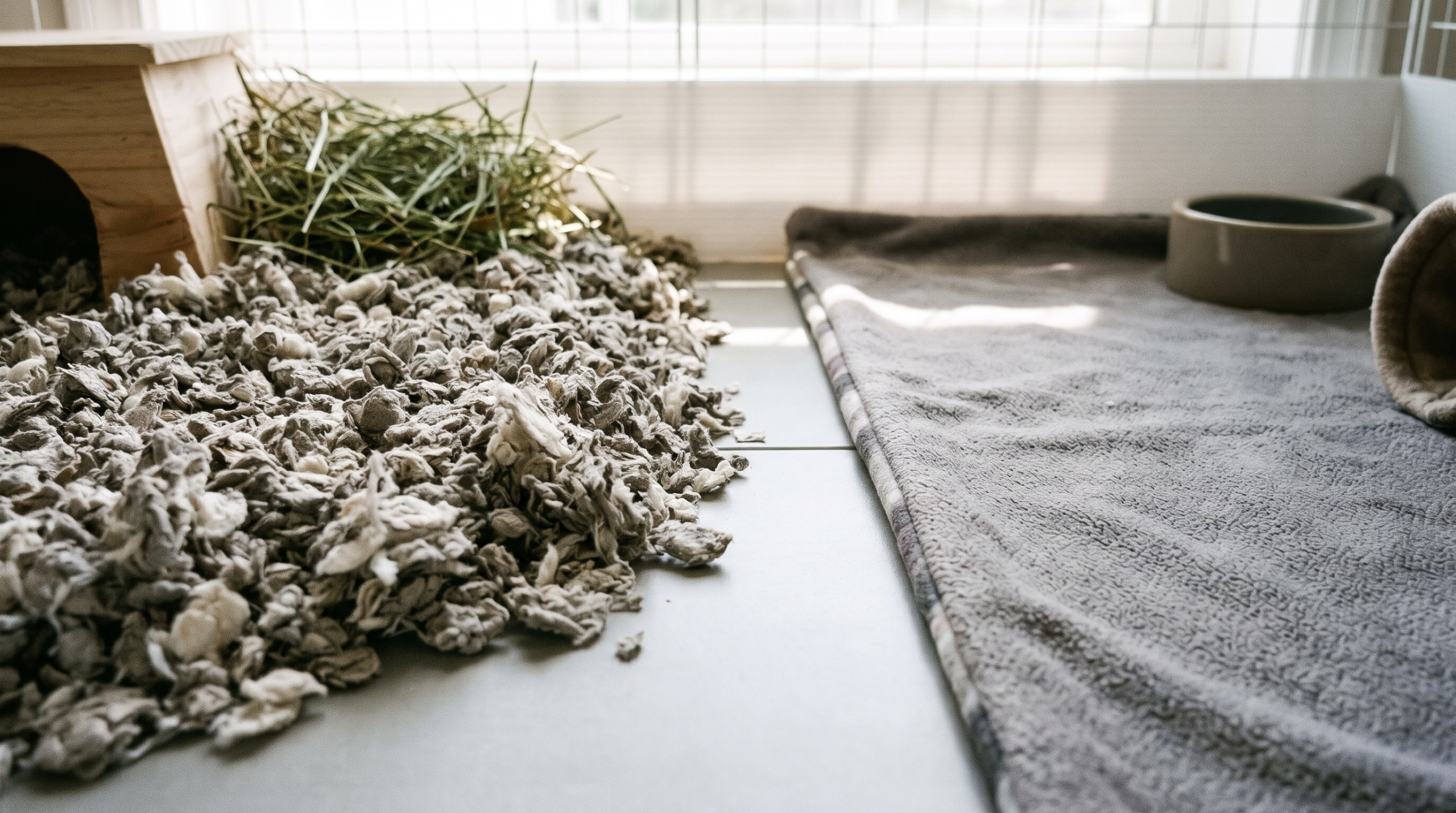
Paper-Based Bedding
Paper-based bedding is a practical option because it can absorb moisture and is generally easy to replace in soiled areas. Choose an unscented, low-dust product made for small animals. Avoid paper bedding that contains loose threads, sharp pieces or added fragrances.
Fleece Liners
Fleece liners provide a reusable surface and can make daily spot cleaning straightforward. They need an absorbent layer beneath them because fleece itself allows liquid to pass through. Remove droppings and wet hay regularly, wash liners as needed and make sure they are completely dry before reuse.
Inspect the fabric frequently. Loose threads, frayed edges or holes can create hazards if a guinea pig chews or becomes caught in them. A guinea pig fleece liner is only a suitable option when it is kept clean, dry and in good condition.
Wood Shavings, Hay and Materials to Avoid
Some guidance, including the RSPCA UK, supports dry, dust-free absorbent wood shavings. The MSD Veterinary Manual identifies kiln-dried pine as an option but warns against raw pine and cedar, while Merck lists paper-based products and fleece as bedding choices. Because advice varies, owners should check the specific material, processing and current veterinary guidance before choosing wood-based bedding. Paper bedding is a straightforward alternative where there is uncertainty.
Avoid dusty sawdust, cedar and raw pine shavings, scented bedding and fluffy cotton-style nesting materials. The RSPCA warns that stringy fluffy bedding can entangle guinea pigs and may be unsafe if eaten. It also cautions against coarse straw because it can injure the eyes.
Hay has two distinct roles. Suitable hay must be available as food, while clean hay can also provide a soft, interesting area for resting and exploring. Feeding hay should be refreshed so it remains clean and dry rather than being left mixed with urine or droppings.
Hiding Places, Hideouts and Tunnels
Guinea pigs are prey animals and need places where they can retreat when they feel uncertain, want to rest or need privacy. An enclosure with no sheltered areas can leave them exposed and uncomfortable.
Provide at least one suitable hideout for each guinea pig, with additional hiding places where space allows. The Merck Veterinary Manual recommends more hiding spots than guinea pigs in the enclosure. For a pair, this means planning for more than two options rather than relying on a single shared house.
Hideouts can include purpose-made wooden shelters, suitable cardboard boxes and appropriately sized tunnels. Choose items with smooth edges and openings large enough for the animal to enter and leave without squeezing. Where practical, hideouts with more than one exit can help reduce the chance of one guinea pig blocking another inside.
Place shelters in different parts of the enclosure so that animals can choose where to rest. Check cardboard regularly and replace it if it becomes wet or heavily soiled. Wooden shelters should be made from untreated, non-toxic material and should be easy to inspect and clean.
Safe hiding places can also make gentle interaction easier. During supervised time outside the enclosure, tunnels and covered boxes give a cautious guinea pig places to retreat while exploring. For more ideas, see these ways to bond with a new guinea pig.
Essential Guinea Pig Cage Accessories
Accessories should support everyday needs without taking up so much room that the animals cannot move freely. A simple, well-arranged enclosure is often more useful than one crowded with decorative products.
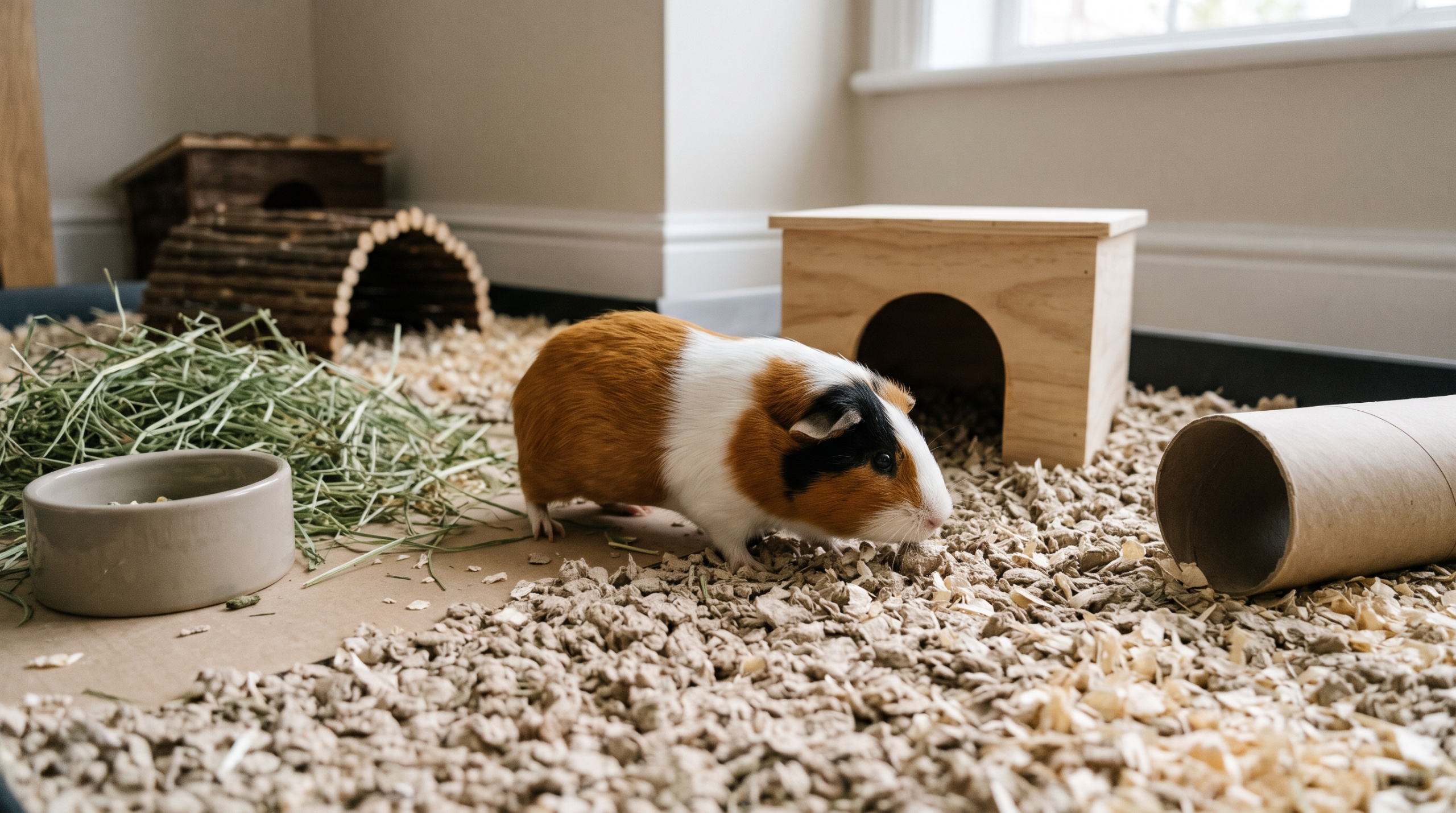
- Hay station or feeding area: Keep feeding hay readily accessible. A clean hay pile or a suitable hay feeder can work, provided the design allows easy access and does not trap the animal. Check that hay stays dry and is not contaminated by urine or droppings.
- Food bowl: A heavy ceramic bowl is less likely to tip than a lightweight dish. Place it where both animals can reach it without being cornered or blocked by a companion. Wash it regularly and remove leftover food that becomes dirty.
- Water bottle or bowl: Provide constant access to clean water. Bottles should be checked to ensure the nozzle works and is not blocked. Bowls should be stable and heavy enough to resist tipping, and they need frequent checks because bedding and food can contaminate them. Merck notes that guinea pigs may drink more from bottles, so if a bottle is used, check its function daily and monitor that each animal is drinking. A bowl can also be used if it remains clean and accessible.
- Shelters and tunnels: These provide cover and encourage exploration. Include enough options to avoid competition and keep entrances clear.
- Chew items: Untreated, suitable wooden items and safe cardboard can provide opportunities to gnaw and investigate. Avoid painted, treated or splintering materials and remove items once damaged.
- Ramps and platforms: These are optional, not a replacement for ground-level space. If included, use a stable, non-slip surface and a gentle ramp. Avoid steep climbs or high platforms from which an animal could fall.
Enrichment and Exercise
A good enclosure gives guinea pigs opportunities to do more than eat and sleep. Tunnels, sheltered routes, safe chew items and foraging activities encourage movement and exploration.
Foraging can be simple. Place some hay in a clean cardboard tube with a wide opening, scatter a small amount of the animal's usual food in a safe area, or use cardboard boxes to create sheltered paths. Any item used for enrichment should be free from staples, tape, sharp edges, toxic coatings and openings that could trap a head or foot.
Rotate selected toys or rearrange a small part of the environment occasionally, while keeping familiar hideouts and essential resources in predictable places. Avoid making frequent major changes that remove all familiar shelter at once.
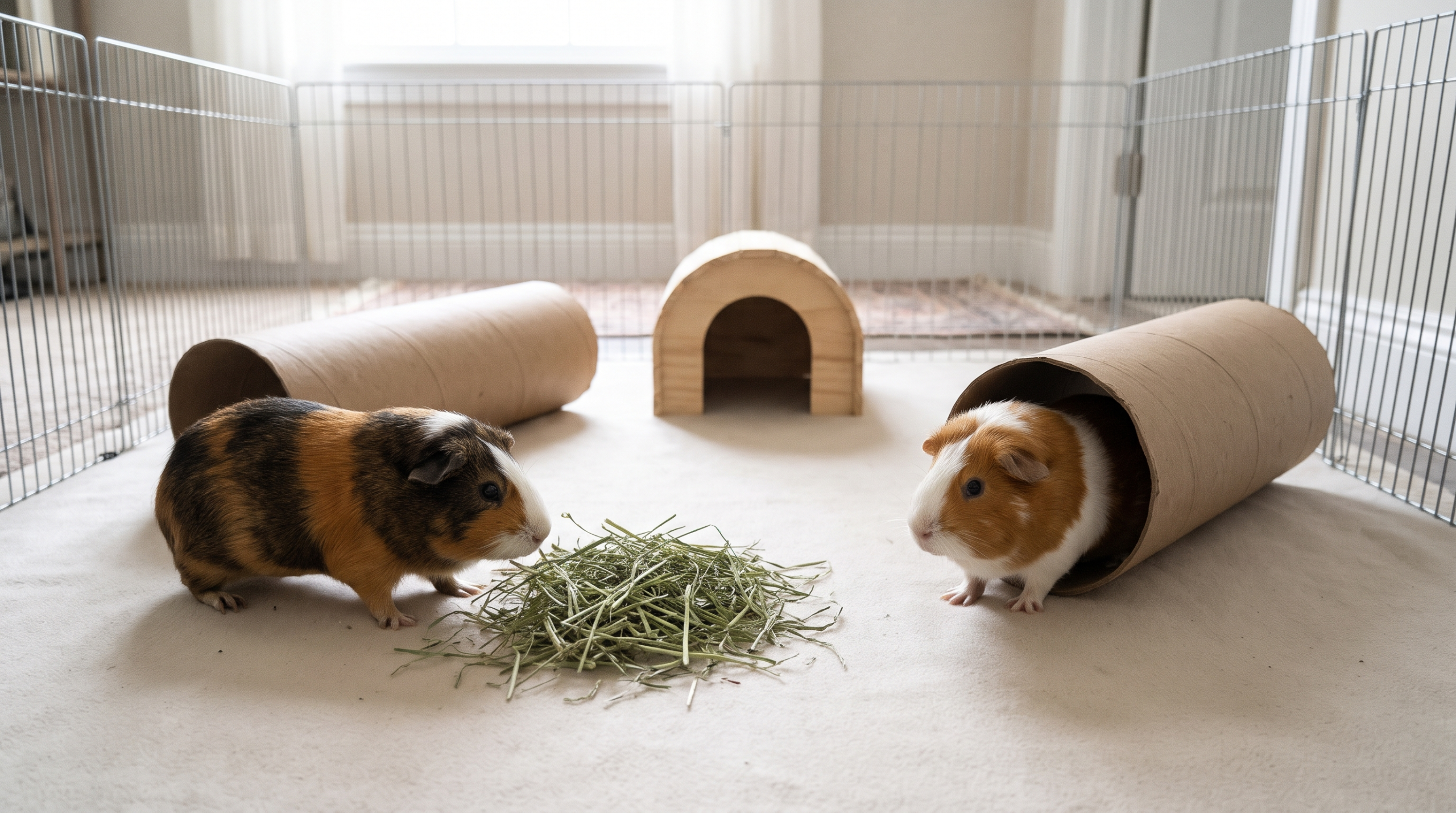
Guinea pigs need safe opportunities to move beyond a cramped enclosure. An attached run or supervised playpen can provide additional space, with tunnels and shelters placed around the area. The MSD Veterinary Manual recommends daily supervised exercise outside the cage in a guinea-pig-proofed space.
Exercise wheels and hamster balls are not appropriate accessories. The MSD Veterinary Manual warns that wheels can injure guinea pigs, and the Ontario SPCA also advises against wheels and exercise balls because they are not designed for guinea pigs. A broad, secure floor area is the better way to support natural movement.
Where to Place a Guinea Pig Cage
Choose a quiet indoor location with good ventilation and a stable temperature. Keep the enclosure away from direct sunlight, radiators, heaters, air-conditioning drafts, cooking fumes and cigarette smoke. A sunny window may cause the enclosure to become too warm even when the room itself feels comfortable.
Temperature recommendations vary by source. The RSPCA UK identifies 17–20°C as an ideal indoor range, while the Merck Veterinary Manual gives 18–26°C as a range tolerated by many home environments. These are not identical recommendations, so it is sensible to aim for a stable, moderate room temperature and avoid extremes or sudden changes. The RSPCA warns that temperatures above 26°C can create a risk of heatstroke and that temperatures below 15°C can leave guinea pigs chilled.
Place the cage where household dogs and cats cannot approach, frighten or reach the animals. A quiet room where normal activity can be observed is preferable to an isolated area or a busy passageway.
Outdoor housing requires extra care. The hutch and run must be protected from direct sun, strong wind, rain, damp ground and predators. The RSPCA advises moving outdoor guinea pigs indoors when temperatures fall below 15°C. Hot weather also needs careful management, with shade, airflow and access to a cooler environment.
How to Arrange a Guinea Pig Cage: Practical Layout
For a pair of guinea pigs, plan the enclosure around clear movement routes and separate resource areas. The exact arrangement will depend on the enclosure's shape, the animals' behaviour and the size of the accessories.
A practical layout might include:
- Feeding area: Keep hay accessible in a clean, dry location. Place the food bowl nearby but leave room for both animals to approach.
- Water area: Position the bottle or bowl where it is easy to reach and check, without placing it beneath a shelf or where bedding can quickly contaminate it.
- Resting areas: Provide several hideouts in different parts of the enclosure, including options that allow each animal to retreat independently.
- Open movement area: Leave a clear central or side section for walking, running and passing one another.
- Enrichment area: Add a tunnel, safe chew item or cardboard activity without blocking access to food, water or shelters.
This is an illustrative arrangement, not a prescribed layout. Watch how the guinea pigs use the enclosure. If one animal repeatedly blocks a resource or prevents the other from entering a hideout, adjust the positions and add alternative access points.
Cleaning and Maintaining the Enclosure
A clean enclosure helps keep bedding dry, limits waste build-up and makes changes in normal behaviour easier to notice. Guinea pigs often eat and rest in the same areas where they pass droppings, so cleaning needs to be frequent.
Spot-clean every day. Remove wet bedding, soiled hay and droppings, especially around sleeping areas, feeding stations and water containers. Refresh hay and water, wash food bowls and check bottles for blockages or leaks.
The RSPCA UK recommends daily spot cleaning and a deep clean at least once a week. It also explains that the frequency of deeper cleaning depends on enclosure size and the number of guinea pigs. A larger enclosure may stay cleaner for longer than a small one, but wet or dirty areas should never be left until the scheduled full clean.
During a deeper clean, move the guinea pigs to a secure temporary area. Remove used bedding, clean the base and accessories with a suitable pet-safe cleaning method, rinse where required and allow everything to dry completely before adding fresh bedding. Retaining a small amount of clean, familiar bedding can help preserve a recognisable scent.
Cleaning is also an opportunity to observe appetite, droppings, breathing and activity. A dirty enclosure does not explain every health problem, but changes in these everyday signs deserve attention. Read more about guinea pig health warning signs so that unusual changes are not overlooked.
Common Guinea Pig Cage Setup Mistakes
Some housing problems come from small decisions that are easy to correct before they become part of the daily routine.
- Choosing a cage that is too small: Measure the usable floor area and compare it with veterinary guidance. Choose a larger enclosure where possible.
- Providing too few hideouts: Add several sheltered options so each guinea pig can retreat without competing for one space.
- Using wire flooring: Replace it with a solid, smooth base and suitable bedding or a liner.
- Ignoring ventilation: Avoid aquariums and enclosed containers that restrict airflow.
- Using unsuitable bedding: Avoid dusty, scented or stringy materials, and keep all bedding dry.
- Placing the enclosure in direct sun or near a heat source: Move it to a stable, well-ventilated location away from temperature extremes.
- Filling every open area with accessories: Keep clear floor space for movement and make sure food, water and hideouts remain accessible.
- Forgetting daily checks: Refresh water, remove wet bedding and observe appetite, droppings and normal activity.
A useful setup is not necessarily the one with the most accessories. It is the one that gives guinea pigs enough space, secure shelter, clean resources and freedom to move.
Frequently Asked Questions
1. How big should a guinea pig cage be for two guinea pigs?
The Merck Veterinary Manual recommends 7.5 sq ft for one guinea pig, plus approximately 2–4 sq ft for each additional animal. For a pair, that works out to 9.5–11.5 sq ft. The MSD Veterinary Manual starts at 7 sq ft for one, plus 2–4 sq ft for another, giving 9–11 sq ft for a pair. These are separate recommendations, and more space is preferable where practical.
2. What is the best bedding for guinea pigs?
Low-dust, absorbent paper bedding is a practical option. Fleece liners can also work when they have an absorbent layer underneath and are kept clean and dry. Some organisations support dust-free wood shavings, while others recommend paper-based alternatives or specify only certain processed woods. Check the material and veterinary guidance before choosing.
3. How many hideouts does a guinea pig need?
Provide at least one hideout per guinea pig. The Merck Veterinary Manual recommends having more hiding places than animals, which helps reduce competition and gives each guinea pig alternative places to retreat.
4. Are fleece liners better than paper bedding?
Neither is automatically better in every setup. Fleece is reusable but needs an absorbent layer and regular washing. Paper bedding is disposable and can be replaced in soiled areas. The best option is one that stays dry, is low in dust and can be maintained consistently.
5. Can guinea pigs live in a C&C cage?
Yes, a properly constructed C&C enclosure can be suitable if it provides sufficient floor space, a solid base, secure panel connections, safe openings and good ventilation. Check that no animal can squeeze through or become trapped in the grids.
6. Do guinea pigs need a separate exercise run?
A secure attached run or supervised exercise area provides useful additional space. The PDSA recommends an outdoor hutch with an attached run, while the MSD Veterinary Manual recommends daily supervised out-of-cage exercise in a guinea-pig-proofed area.
7. Can guinea pigs use a hamster wheel?
No. Exercise wheels are unsuitable for guinea pigs and can cause injury. Provide a spacious, secure area where they can move naturally instead.
8. How often should a guinea pig cage be cleaned?
Spot-clean daily and carry out a deeper clean at least weekly as a general starting point. The exact frequency depends on enclosure size, bedding type and the number of guinea pigs. Remove wet or heavily soiled bedding whenever it appears.
9. Should a guinea pig cage have a roof?
Not always. An open-top enclosure may be suitable in a secure home without access from other pets or hazards. A lid or protective cover may be necessary where cats, dogs or small children could reach the enclosure. Any cover must allow good airflow.
10. Where should a guinea pig cage be placed?
Choose a quiet, well-ventilated area away from direct sunlight, heaters, draughts, fumes and household pets. Keep the temperature stable and avoid locations that become hot or cold during the day.
Veterinary and Animal-Welfare References
The following sources provide further information about guinea pig housing, bedding, temperature, cleaning and enrichment. Their recommendations are not identical in every area, so the relevant guidance has been identified in the sections above.
- Merck Veterinary Manual: Housing and Nutrition of Guinea Pigs — veterinary guidance on enclosure floor area, solid flooring, ventilation, bedding, hiding places, water and temperature.
- MSD Veterinary Manual: Providing a Home for a Guinea Pig — pet-owner guidance on cage dimensions, solid flooring, bedding, exercise, enrichment and avoiding exercise wheels.
- RSPCA UK: Creating a Good Home for Guinea Pigs — social housing, temperature, ventilation, bedding, hiding places, exercise and cleaning frequency.
- PDSA: The Ideal Home for Your Guinea Pigs — outdoor hutch and run dimensions, weather protection, exercise space and enrichment.
- UC Davis School of Veterinary Medicine: Guinea Pig Care — additional veterinary information on solid flooring, bedding, water hygiene, temperature and supervised exercise.
- Ontario SPCA: What Can Guinea Pigs Play With? — enrichment suggestions and advice against exercise wheels and exercise balls.
Conclusion: Creating a Comfortable Guinea Pig Home
A good guinea pig cage setup starts with enough usable floor space and a solid, comfortable base. Suitable bedding, multiple hideouts, accessible food and water, safe enrichment and clear movement areas help create an enclosure that supports everyday welfare.
Regular spot cleaning, weekly deeper cleaning and attention to temperature and ventilation are equally important. Rather than choosing a cage based only on its advertised size or accessories, owners should assess how much room the guinea pigs actually have to move, rest, hide and interact. A spacious, clean and thoughtfully arranged enclosure provides a stronger foundation for long-term care.
Ready to Learn More?
Explore more practical advice in PetStory's Small Pets section, including guides to guinea pig health, bonding and everyday care.
Explore ways to bond with a new guinea pig and build a calm, positive relationship with a companion pet.
About the Author
Irfan Hyder is the editor of PetStory.org, an independent publication covering pet care, adoption, nutrition and behaviour. He has spent around 8 years caring for pets at home, including his Golden Retriever, Max, his Persian cat, Luna, and pet birds, and writes alongside veterinary and reputable sources.