Table of Contents
Bringing a new puppy home ranks among the most genuinely joyful experiences a person can have — and also among the most unexpectedly overwhelming. The excitement is real, but so is the reality check that arrives approximately forty minutes after the puppy does, when the chewing starts, the whining begins, and the carefully planned “calm introduction” dissolves into controlled chaos.
The transition a puppy makes in those first twenty-four hours is significant. One day they are surrounded by their mother, their littermates, and every smell they have ever known. The next, they are in an entirely foreign environment with strangers, unfamiliar sounds, and no familiar comfort in sight. Understanding that context — genuinely sitting with how disorienting that experience must be for a young animal — is the foundation of everything that follows in this guide.
With the right preparation, a clear routine, and a reasonable amount of patience, those first twenty-four hours can set the tone for a relationship that will last a decade or more. Here is exactly how to navigate them.
Preparing for Arrival

The single most underrated factor in a successful first day is what happens before the puppy arrives. A prepared home lets the focus stay where it belongs — on the puppy — rather than on scrambling for supplies or realizing too late that the kitchen cupboards are at nose height.
Puppy-Proofing the Home
Puppies experience the world primarily through their mouths. Before bringing one home, the entire living space deserves a thorough audit from roughly six inches off the ground. Electrical cords need to be secured or concealed — a puppy can chew through a live wire before anyone notices. Toxic houseplants, which include more common varieties than most people realize, should be moved to inaccessible locations or removed entirely. The ASPCA maintains a comprehensive database of plants toxic to dogs that is worth checking before the puppy comes home.
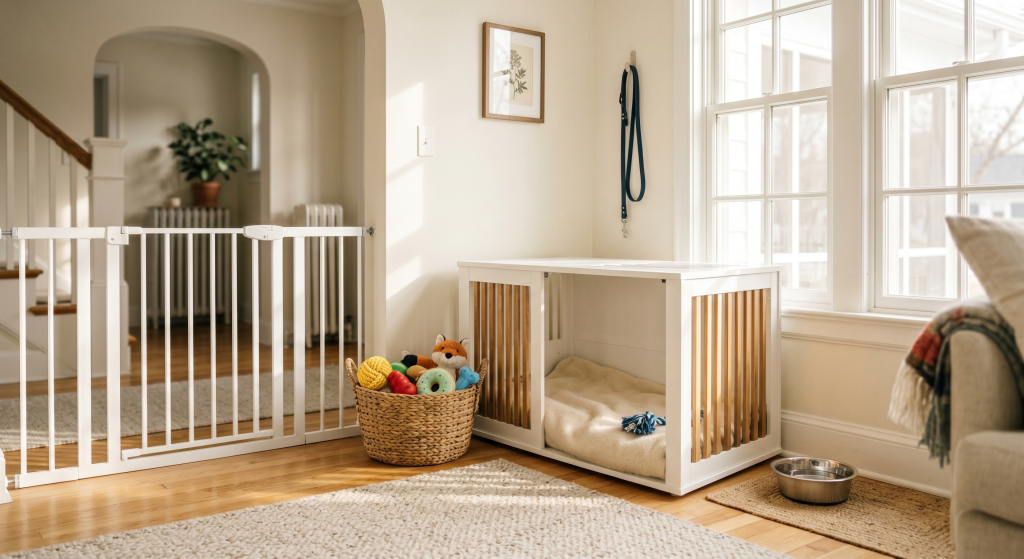
Small objects that could be swallowed — coins, hair ties, children’s toys, remote control batteries — need to disappear from floor level entirely. Baby gates are worth installing before day one to establish clear boundaries around which rooms are accessible and which are off-limits. Creating a defined “puppy zone” in the early weeks is not restrictive; it is genuinely kind, giving a young dog a manageable territory to learn rather than an overwhelming expanse to navigate.
The Essential Supply List
Having everything ready before the puppy arrives prevents the specific stress of realizing a crucial item is missing at 11pm on the first night.
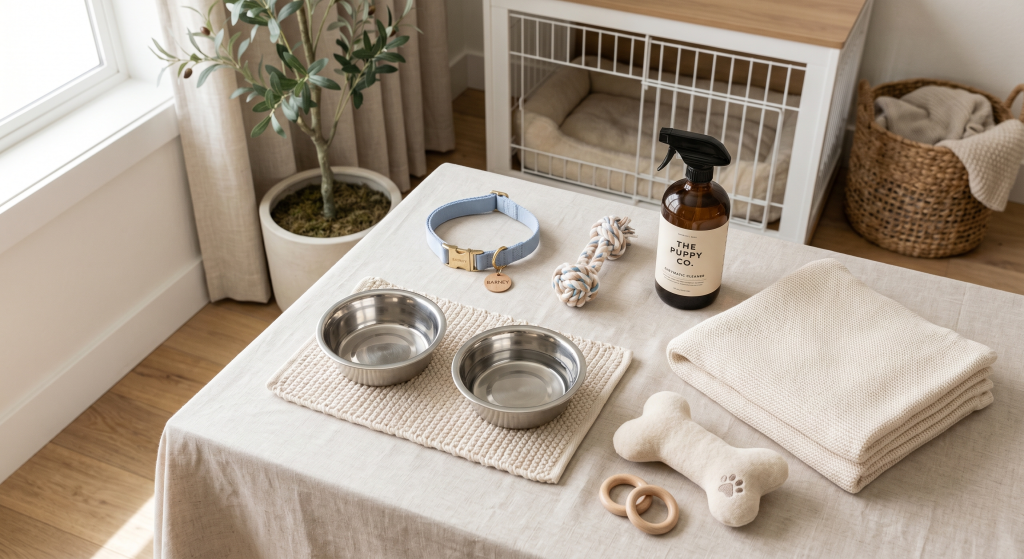
The non-negotiables are a crate sized appropriately for the breed — large enough for the puppy to stand, turn around, and lie down comfortably, but not so large that one end becomes a designated bathroom — along with high-quality puppy food matching what the breeder or shelter was feeding, stainless steel or ceramic food and water bowls, a well-fitted collar with an ID tag, a leash, and enzymatic cleaner for the inevitable accidents. Standard household cleaners do not fully eliminate the odor markers that tell a puppy a spot has been used before; enzymatic cleaners do.
Comfort items deserve particular attention. A soft blanket that carries the scent of the puppy’s mother or littermates — many breeders will provide one if asked — can make a meaningful difference on the first night. A worn item of the new owner’s clothing placed in the crate serves a similar function, replacing one familiar scent with another.
The Homecoming: Setting the Right Tone
The moment of arrival carries more weight than most new owners anticipate. The instinct is to invite family and friends, to document everything, to let the excitement of the occasion fill the house. Resist all of it. The first day should be deliberately quiet. One or two calm adults at most. No neighborhood children, no extended family introductions, no parties.
The First Stop: Potty Before Anything Else
Before the puppy crosses the threshold into the home, take them directly to the designated outdoor bathroom spot. Keep the leash on, stay calm, and give them a few minutes to sniff and explore. If they go, offer quiet praise and a small treat. If they don’t, that is fine — bring them back to this exact spot every thirty to forty-five minutes throughout the day. This single habit, begun in the first five minutes of homecoming, is the foundation of house training.
Introduction to the New Environment
Once inside, allow the puppy to explore their designated zone at their own pace with the leash still attached and trailing loosely. Resist the urge to carry them from room to room or introduce them to every corner of the house simultaneously. Let them lead, let them sniff, let them investigate at the speed their nervous system can manage. The goal of the first hours is simple: the puppy should begin to register that this new place is safe.
Loud noises, sudden movements, and excessive handling in these early hours work against that goal. Children need to be briefed before the puppy arrives — calm voices, gentle hands, no chasing.
Introducing the Crate
The crate introduction cannot wait until bedtime. Begin it within the first hour of arrival. Leave the crate door open, toss a few treats inside, and allow the puppy to investigate freely. A meal fed just inside the crate entrance — not yet inside, just at the threshold — builds a positive association without forcing anything. The crate should never be used as punishment, and the puppy should never be forced inside. Every positive association built during the first afternoon pays dividends at midnight.
The First Afternoon: Building a Routine
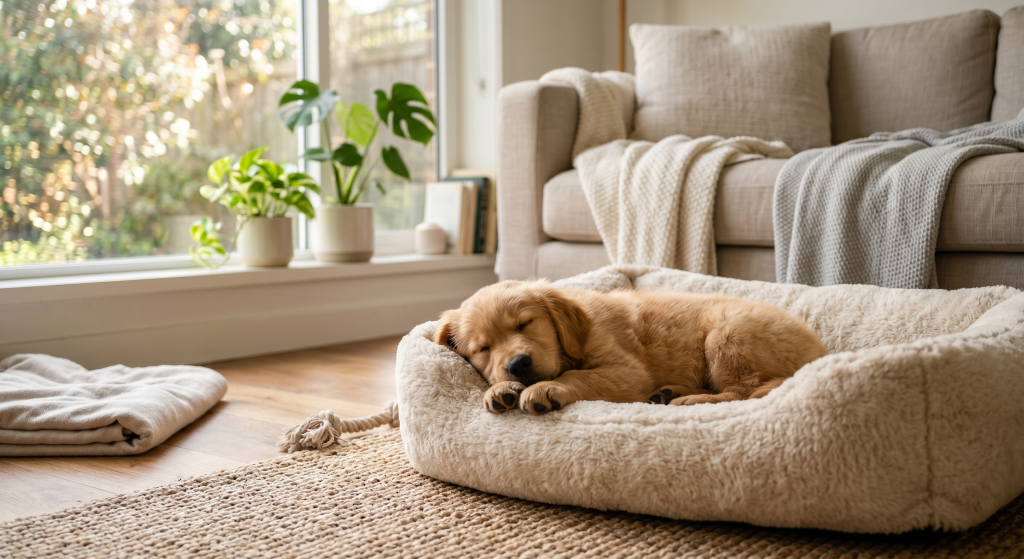
Dogs are creatures of routine in a way that is not merely preference — it is neurological. Predictable schedules reduce anxiety by making the environment legible. A puppy who knows when food is coming, when outdoor time happens, and when rest is expected is a calmer, more settled puppy than one navigating an unpredictable household.
Feeding Schedule
Young puppies require three to four small meals daily rather than one or two larger ones. Their stomachs are small and their metabolisms are high, and consistent feeding times create predictable windows of digestive activity that make house training considerably more manageable. A puppy generally needs to eliminate within fifteen to thirty minutes of eating — knowing when meals happen means knowing when to head outside.
Ask the breeder or shelter what the puppy was eating and when. Maintain that schedule and that food for at least the first week. Changing both the environment and the diet simultaneously is a reliable path to digestive upset, which complicates an already demanding first few days.
Play, Exploration, and Rest
A young puppy’s energy is episodic rather than sustained. Intense play for fifteen to twenty minutes is typically followed by a nap of one to two hours. These sleep cycles are not laziness — they are neurological necessity. Puppies do most of their brain development during sleep, and an overtired puppy becomes irritable, nippy, and increasingly difficult to manage.
During awake periods, play should involve toys rather than hands. Teaching a puppy early that human hands are for gentle contact rather than for biting or wrestling prevents habits that become problematic as the dog grows. The American Kennel Club’s puppy training resources offer excellent guidance on bite inhibition and early play boundaries.
During rest periods, practice brief crate time with the door closed. Start with two to three minutes, stay visible, and offer calm praise when the puppy settles. These short sessions build the crate tolerance that the first night will require.
The First Potty Training Pattern
By the end of the first afternoon, a rough pattern should be emerging: outside immediately after waking, outside fifteen to thirty minutes after eating, outside after any period of active play. Accidents will happen — respond without drama, clean thoroughly with enzymatic cleaner, and move on. Scolding a puppy for an accident, particularly one that occurred more than a few seconds earlier, achieves nothing except eroding trust.
For a deeper dive into house training timelines and methods, the guidance published by Blue Cross for Pets on toilet training puppies provides a clear, research-informed framework.
Surviving the Night: The Biggest Challenge
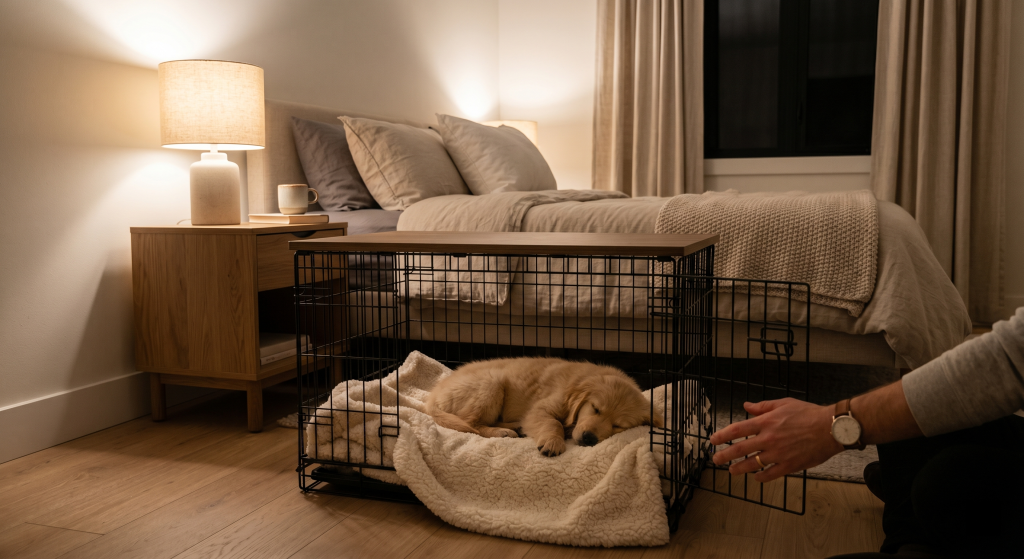
The first night is genuinely the hardest part of the first twenty-four hours, and the difficulty is worth naming honestly rather than minimizing. A puppy who has never slept alone, who has always had the warmth and smell and sound of littermates surrounding them, is now in a dark, quiet space by themselves for the first time in their life. Crying is not misbehavior. It is a completely appropriate response to a genuinely strange situation.
Crate Placement
For the first several nights, the crate belongs in the bedroom — ideally positioned so the puppy can see or smell the owner without being on the bed. This placement is not about spoiling the dog; it is about providing the biological reassurance that they are not alone. A puppy who can hear breathing and smell a familiar person is a puppy who settles significantly faster than one isolated in a distant room.
As the weeks pass and confidence builds, the crate can be moved gradually — a few feet at a time — toward its permanent location.
The Bedtime Routine
Consistency in the wind-down sequence matters. Begin by removing access to water approximately two hours before the intended bedtime, which reduces the likelihood of a nighttime elimination need without dehydrating the puppy. Take the puppy outside to the bathroom spot immediately before putting them in the crate — and stay out long enough to give them a genuine opportunity to go, not just a brief supervised moment.
Place the puppy in the crate with a safe chew toy or a Kong stuffed with a small amount of puppy-appropriate food. A ticking clock wrapped in a towel, placed near but not inside the crate, can simulate a heartbeat and provide subtle comfort. A warm water bottle — not hot — wrapped in a blanket serves a similar function.
Keep the room calm. Dim the lights. Avoid extended eye contact or prolonged goodnight rituals, which signal to the puppy that bedtime is an event requiring anxiety rather than a normal transition into rest.
Handling Nighttime Crying
When the crying begins — and it likely will — the response requires both empathy and discipline in equal measure. Wait thirty seconds before reacting. Many puppies will escalate briefly and then settle when they realize the environment is stable and safe. Rushing in at the first whimper teaches a very efficient lesson: crying produces attention.
If the crying continues beyond a minute, assess the likely cause. If the puppy has not been outside in two or more hours, assume a bathroom need and respond accordingly: leash on, outside quietly, minimal interaction, straight back to the crate after elimination. No play, no talking, no lingering.
If the puppy has just been out and is crying without apparent cause, the crying is almost certainly attention-seeking. This is the hardest moment of the first night — and possibly of the first several nights. Responding to it consistently, by not responding, is not unkind. It is how a puppy learns that nighttime is for sleeping, not for social interaction.
Nighttime Potty Breaks
Young puppies, particularly those under twelve weeks, physically cannot hold their bladder through a full night. Expect at least one, possibly two, nighttime elimination trips in the first weeks. Set an alarm rather than waiting for the puppy to cry — proactive bathroom trips prevent accidents and avoid reinforcing the association between crying and being let out.
As the puppy grows and bladder control develops, the nighttime trips extend naturally and eventually disappear. Most puppies can sleep through the night by around sixteen weeks, though individual variation is significant.
The Next Morning: Success
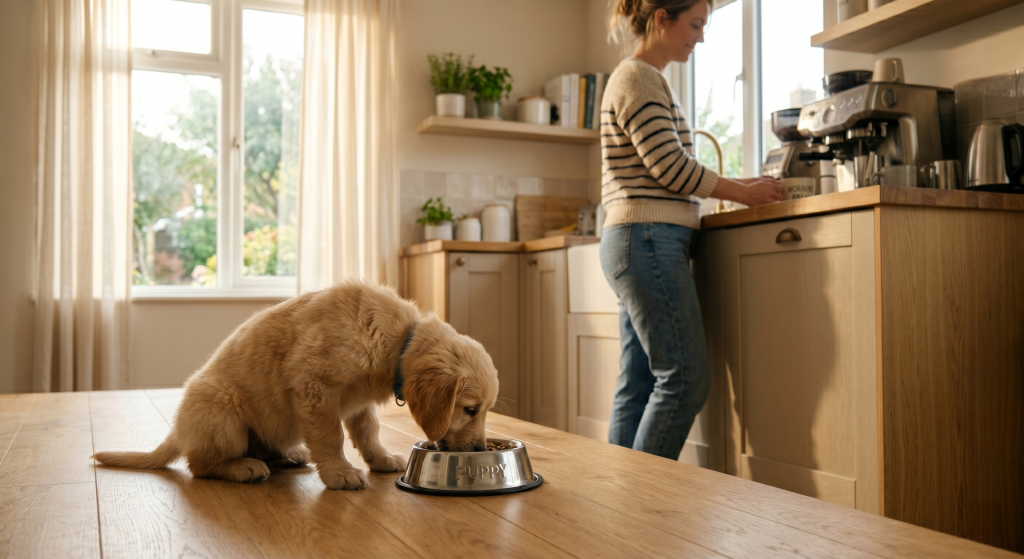
Sunrise on the first morning carries a particular quality of relief that any new puppy owner will recognize. The night is over. The puppy is alive and apparently undamaged. The owner has survived.
The first task of the morning is identical to the last task of the night: outside immediately. Before coffee, before checking a phone, before anything else. A puppy who wakes up and goes straight outside for a successful bathroom trip starts day two with a success, and that pattern — waking up, going outside, positive reinforcement — is the repetition that makes house training stick.
Feed breakfast on schedule, refresh the water, and take a moment to acknowledge that the hardest twenty-four hours are behind. The anxiety that accompanied the puppy’s arrival does not disappear overnight, but it begins to reduce as patterns become established and the puppy begins to show the first signs of settling into their new home.
Building on Day One
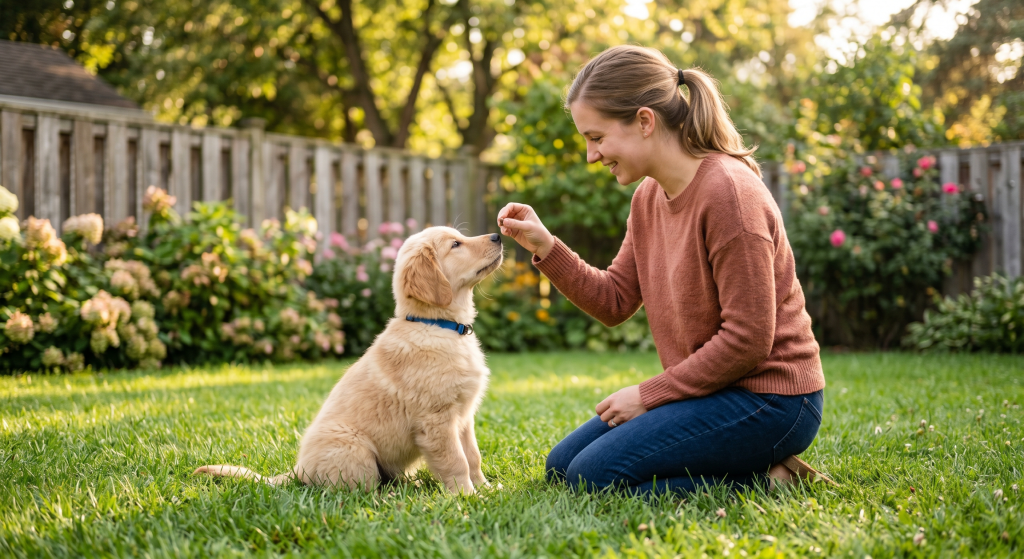
The first twenty-four hours are not the destination — they are the foundation. Every consistent response to the puppy’s needs during this period is a deposit into a trust account that will compound over years. The puppy who learns in the first day that their crate is safe, that humans respond to genuine needs without drama, and that their new home is a predictable and calm environment is a puppy whose training and socialization will proceed from a position of security rather than anxiety.
The exhaustion of the first night fades. The puppy grows into the space. The routines that feel effortful now become automatic within weeks. What remains, long after the details of those first twenty-four hours have blurred, is the relationship that was quietly built during them.
For more puppy care guidance, feeding advice, and training resources, explore the full library of articles at PetStory.org.
The information in this article is intended for educational and informational purposes only and does not constitute professional veterinary advice. Every puppy is different, and individual needs may vary based on breed, age, and health status. Always consult a licensed veterinarian for guidance specific to your pet.