
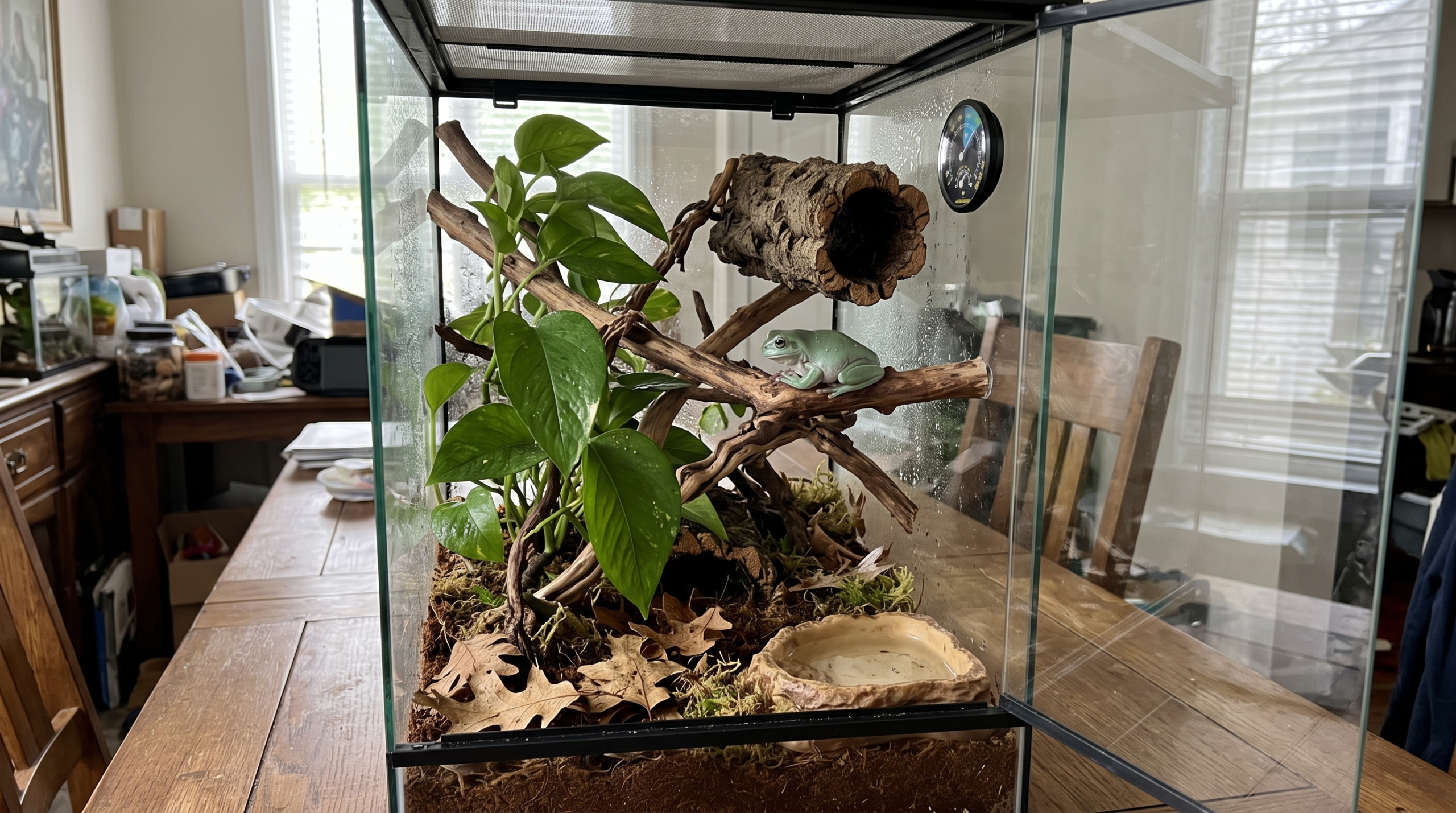
The best frog habitat is the one built around a specific species, not the one that looks best in a photo. A tall, leafy terrarium that suits a tree frog would be a poor fit for a fully aquatic frog that never leaves the water, and the reverse is just as true. Before you buy a tank, a lamp, or a single plant, you need to know which frog is coming home, how large it will grow, and how it lives in its natural frog habitat.
This guide walks through the main enclosure types, tank size, substrate, plants, temperature, humidity, ventilation, water quality, and lighting, and it points out where care sources disagree. Amphibians absorb water and chemicals through their skin, so small setup errors matter more than many beginners expect. Where a number appears below, treat it as an example for one species from the cited source, not a rule for every frog habitat.
Table of Contents
- Why Every Frog Habitat Starts With the Species
- Terrestrial, Arboreal, Aquatic, and Semi-Aquatic Setups
- Choosing a Frog Habitat Tank Size
- Height, Ventilation, and Secure Lids
- Frog Substrate, Drainage Layers, and Bioactive Setups
- Plants for Frog Habitat Terrariums, Branches, and Hides
- Frog Habitat Enclosure Temperature, Humidity, and Ventilation
- Water Quality, Dechlorination, and Safe Water Features
- Lighting and UVB for Frogs
- A Naturalistic Frog Habitat Terrarium That Stays Clean
- Common Frog Habitat Setup Mistakes
- Warning Signs and When to Contact an Exotic Vet
- Beginner Frog Habitat Setup Checklist
- Frequently Asked Questions
- Conclusion
Why Every Frog Habitat Starts With the Species
Frogs share a few traits that shape every setup. They are ectotherms, so their body temperature follows their surroundings, and their skin takes in water and, unfortunately, toxins. That is why a pet frog habitat is less forgiving than it looks.
The MSD Veterinary Manual says most amphibians do well at roughly 60 to 70°F and around 75 to 80% humidity, but it also says a vet with amphibian experience can advise on specific needs. Look at one popular species and the numbers shift. A veterinary information sheet from Lafeber lists a daytime gradient of 70 to 90°F and humidity of 60 to 70% for White's tree frogs. Neither source is wrong. One describes amphibians in general; the other describes a single species.
So start with three questions. How big will this frog get? Does it live on the ground, in the branches, in the water, or between them? And what temperature and humidity range does its species need? Every later decision follows from those answers.
Terrestrial, Arboreal, Aquatic, and Semi-Aquatic Setups
Frogs do not share one enclosure design. Matching the layout to the animal's lifestyle comes first.
Terrestrial Frog Habitat
Ground-dwelling frogs need floor space, hiding places at ground level, and a substrate that holds moisture. The MSD Veterinary Manual notes that even terrestrial species need a shallow water container. Burrowing species also benefit from substrate deep enough to dig into, so check your species' habits before choosing depth.
Arboreal Frog Habitat
Tree frogs climb, so height and surfaces matter more than floor area. Chewy's beginner guide points out that screen enclosures suit species needing high ventilation, such as tree frogs. A veterinary proceedings article on amphibian husbandry adds a detail beginners often miss: arboreal frogs will not use a cave on the substrate, so hides must be placed up in the branches, not just on the ground. Merck's manual mentions that plastic tubing such as PVC can serve as a perch or hide for arboreal species.
Aquatic Frog Habitat Tank Setup
Fully aquatic frogs live more like fish than like tree frogs. Merck describes aquatic amphibians as being accommodated in aquariums with room to swim. The African dwarf frog is the usual beginner example. It needs a filtered, heated aquarium with dechlorinated water, hiding places, and a tight lid.
Semi-Aquatic Setups
Some frogs need both land and water. Chewy describes a paludarium, a hybrid enclosure with land and water sections, as mainly used for semi-aquatic species. In a setup like this, make sure the frog can enter and leave the water easily and has a dry, secure area as well.
Choosing a Frog Habitat Tank Size
There is no single tank size for pet frogs. The right size depends on adult size, activity level, how many frogs share the space, and whether the species lives on the ground, in branches, or in water.
White's tree frogs show how far guidance can vary. A retailer care sheet recommends at least 18 x 18 x 24 inches for one frog, while another guide gives 20 gallons as a minimum and stresses an enclosure taller than it is wide. Reptiles Magazine calls a 20-gallon horizontal tank a minimum for four young frogs. Lafeber's veterinary sheet says the species does not need much space. Reading these side by side, the safest approach is to treat the smallest figure as a floor, not a target, and to buy for the adult frog, not the juvenile you bring home.
Aquatic frogs follow a different logic, because volume of water matters more than height. Colorado Exotic Animal Hospital recommends at least 2 gallons of water per African dwarf frog, while PetSmart's guide suggests 5 gallons or more. Beginners generally find larger volumes easier to keep stable in an aquatic frog habitat, though this is practical reasoning rather than a figure from a single source.
When setting up a frog habitat, separate floor space from vertical climbing space. A long, low tank gives a terrestrial frog room to roam but wastes a tree frog's preference for height, and a tall tank with little floor area can short-change a ground dweller.
Height, Ventilation, and Secure Lids
Whatever the species, the lid must be secure. The veterinary proceedings article stresses that amphibian enclosures need to be escape-proof. Aquatic frogs add one more consideration: Reptiles Magazine notes that African dwarf frogs need access to air at the surface, so use a screen lid or keep a solid lid slightly open.
Frog Substrate, Drainage Layers, and Bioactive Setups
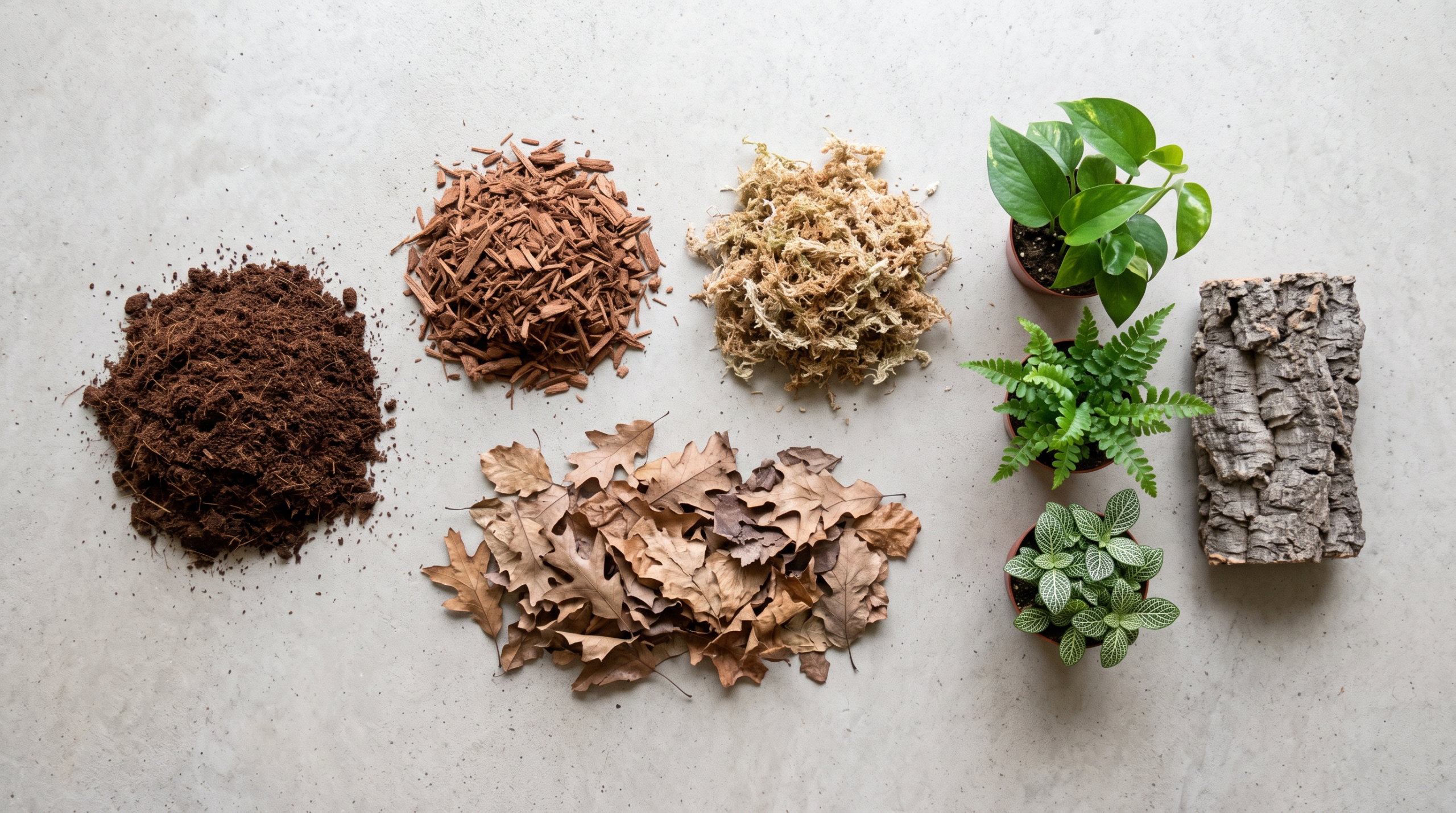
Substrate does more than cover the floor of your frog habitat. It holds moisture, creates humidity pockets, and gives the frog a surface to rest on.
The MSD Veterinary Manual notes that organic substrates and shelter can help limit water loss. The veterinary proceedings article describes a moisture gradient in the substrate, so the frog can choose drier or damper spots, and says substrate should be moist without being foul. Reptiles Magazine suggests fine soil or ground coconut fiber for White's tree frogs because the particles are small enough not to harm the gut if swallowed by accident. A veterinary information sheet on White's tree frogs lists coconut husk fiber or cypress mulch, with substrate replaced and the enclosure disinfected monthly or more often.
Drainage layers deserve a careful note. The proceedings article mentions a layer of pea gravel, sometimes covered with moss, leaf litter, mulch, or soil, as one basic option, using the words "may or may not." That is a reminder that a drainage layer is one design choice, not a requirement for every enclosure. Chewy advises asking a vet or amphibian expert about layering so substrate does not become overly saturated.
Simple setups are also acceptable. Merck notes that moist paper towel is adequate for most species, which makes it a practical, hygienic option for temporary or quarantine housing. Aquatic frogs differ again: for African dwarf frogs, Colorado Exotic Animal Hospital recommends gravel too large to be swallowed.
Bioactive setups, which use living cleanup crews and plants to process waste, can work well but depend on a balanced system. They are not a shortcut around cleaning or monitoring.
Plants for Frog Habitat Terrariums, Branches, and Hides
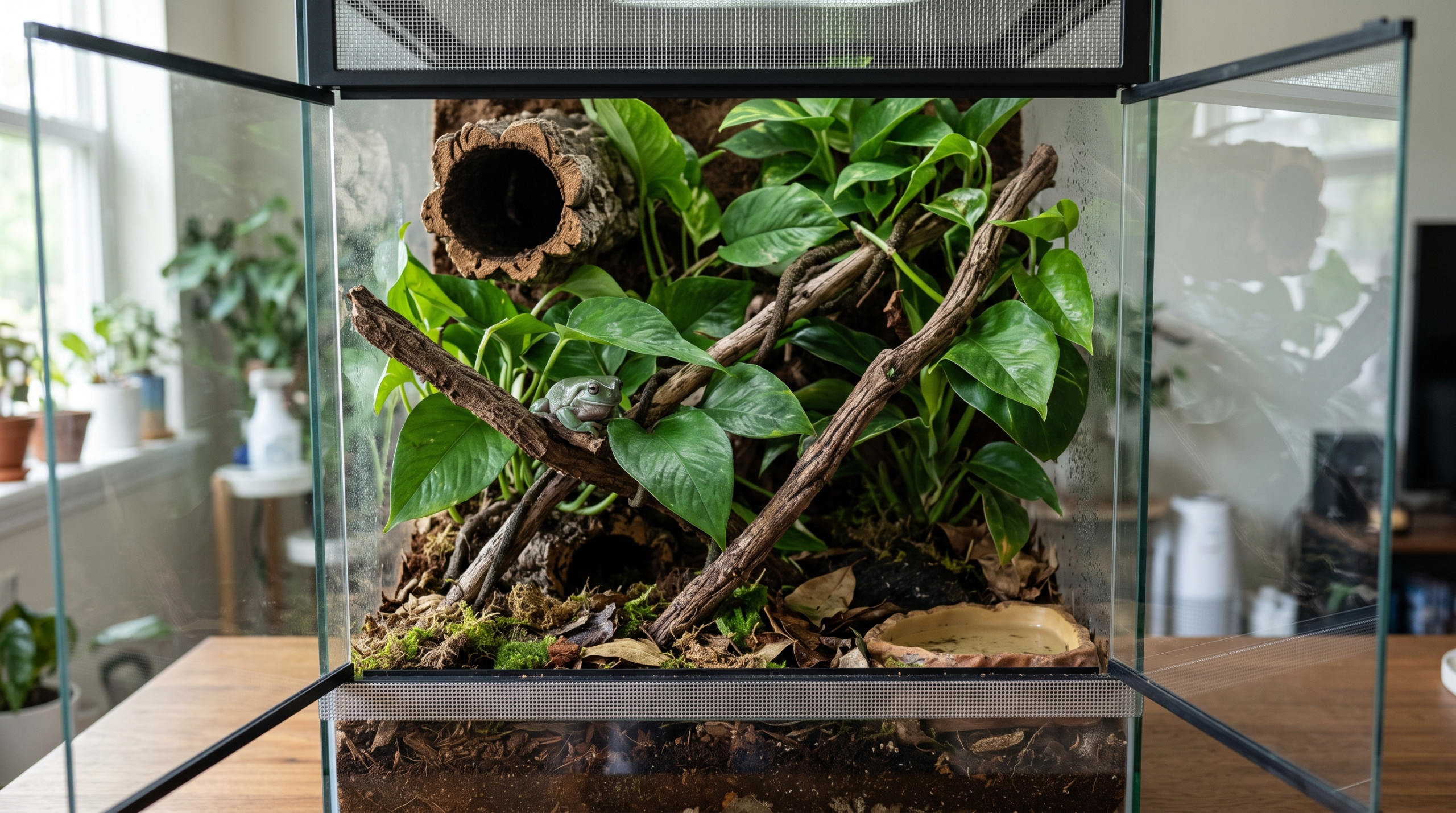
Plants and decor give frogs cover, climbing routes, and humidity within the frog habitat. They also bring risks.
Not every plant is safe for amphibians. The MSD Veterinary Manual advises checking with an experienced amphibian keeper, breeder, or vet before adding plants, and says water must be free of pesticides. Buy plants from sources that confirm they are pesticide-free, rinse them, and research each species against your frog. A veterinary sheet on White's tree frogs lists live or artificial plants as acceptable for cover and humidity, so artificial plants are a reasonable choice if you want fewer variables.
For aquatic frogs, Merck notes that aquatic plants oxygenate the water, take up nitrogenous waste, and offer hiding places.
Choose branches and hides that suit the species. Tree frogs need sturdy, secure branches at several heights, with some thicker than the frog's body. Terrestrial frogs need low hides, and the proceedings article recommends multiple hide areas within the temperature, humidity, and light gradient. Everything should be stable, smooth, and easy to remove for cleaning. Avoid collecting wood, moss, or plants from the wild, which can introduce pathogens, pesticides, or other contaminants, and may raise legal or conservation concerns.
Frog Habitat Enclosure Temperature, Humidity, and Ventilation
Heat, humidity, and airflow work together, which is why adjusting one often changes another.
Merck's manual says adequate ventilation, described as one to two fresh air changes per hour, is needed to prevent disease. The proceedings article explains the tension: ventilation is hard to maintain without losing humidity, so keepers tinker with the setup, and water features or misting can help reach humidity goals without sacrificing airflow. Permanently soaked substrate, stagnant air, or maximum humidity is not the goal for any species. A humidity gradient is generally better than a single reading.
Temperature varies even among tree frogs. For White's tree frogs, Lafeber lists a gradient of 70 to 90°F with night temperatures of 65 to 70°F, while a retailer care sheet suggests a basking spot of 82 to 84°F, ambient air of 74 to 76°F, and nights of 65 to 72°F. African dwarf frogs are different again: Colorado Exotic Animal Hospital recommends 78 to 82°F, never above 85°F or below 70°F, while PetSmart gives 70 to 82°F. When sources differ, follow species-specific veterinary guidance and verify with a thermometer.
If a heat source is needed, keep it outside the frog's reach, regulate it, and check temperatures at the frog's level. Merck recommends spot-checking enclosures daily with a laser temperature probe. Use a hygrometer as well. Chewy suggests asking your vet if you are unsure of your frog's humidity range. A separate source notes that incorrect humidity or temperature can lead to dehydration, stress, and slow growth in young amphibians.
Water Quality, Dechlorination, and Safe Water Features
Frog skin absorbs water, and it absorbs whatever is in it. The MSD Veterinary Manual says water must be free of chlorine, ammonia, nitrite, pesticides, and heavy metals. The CDC also lists amphibians among animals that should not be kept in water containing chlorine or chloramine. Tap water often contains chlorine or chloramine, which are harmful to amphibians and must be removed before adding it to the frog habitat.
Not all treatments work the same way. According to the MSD Veterinary Manual, chlorine can be removed by circulating tap water through a carbon filter for at least 24 hours, but if tap water contains chloramines, a specific dechlorinating agent should be used first. Caudata.org adds that letting water sit overnight will not remove chloramine. Your water supplier can tell you which disinfectant is used.
The MSD Veterinary Manual also says distilled water should not be used in amphibian enclosures, and recommends reading bottled water labels and testing when unsure. This matters because some care sheets suggest distilled water for misting, so check what your own vet advises.
Match the water feature to the species. A shallow dish with easy entry and exit suits many land frogs. A shallow water area suits semi-aquatic frogs. Fully aquatic frogs need filtered tanks with routine testing. For African dwarf frogs, Colorado Exotic Animal Hospital suggests replacing 10 to 20% of the water weekly with dechlorinated water and removing waste promptly.
Lighting and UVB for Frogs
Lighting is one of the least settled parts of frog care, and the sources do not agree. The MSD Veterinary Manual says UVB lighting is required to prevent metabolic bone disease in amphibians. Some keeper-focused guides, by contrast, describe UVB for White's tree frogs as beneficial but not strictly required when the diet is properly supplemented, and recommend gentle, low-intensity lighting rather than reptile-grade lamps.
In practice, this means you should not assume your frog needs the same lighting as a lizard, and you should not assume it needs none. Ask an exotic vet who treats amphibians which lighting suits your species. Whatever you choose, provide shaded areas and a regular day and night cycle, and make sure lamps cannot overheat the enclosure or burn the frog.
A Naturalistic Frog Habitat Terrarium That Stays Clean
A beautiful terrarium is not automatically a good frog habitat. It only works if it meets the frog's biological needs and can be cleaned, inspected, and reached easily. Keep decor secure so nothing can fall or trap the frog, leave open sightlines so you can check on it, and avoid overcrowding the space with plants.
Cleaning needs a routine. Chewy describes removing decor, substrate, and accessories, cleaning them with a frog-safe disinfectant, rinsing thoroughly, and replacing them. A guide to juvenile amphibian setups suggests spot cleaning terrestrial setups daily and doing a full clean weekly, though your schedule should reflect your species, stocking, and substrate. Merck adds a biosecurity note: because of the risk of pathogenic pollution, used substrate and furniture should be properly decontaminated before disposal.
Common Frog Habitat Setup Mistakes
- Buying the enclosure before choosing the species, then hunting for a frog to fit it
- Sizing the tank for a juvenile instead of the adult
- Copying a tree frog setup for a ground-dwelling or aquatic species
- Keeping substrate soaked and air stagnant in the name of humidity
- Using untreated tap water, or treating for chlorine when the supply contains chloramine
- Adding plants without checking that they are safe and pesticide-free
- Relying on decor and plants that are hard to clean
- Placing heat sources where the frog can touch them
- Guessing temperature and humidity instead of measuring them
- Collecting plants, wood, or animals from the wild
Warning Signs and When to Contact an Exotic Vet
Habitat problems can show up in the animal. Reduced appetite, unusual lethargy, ongoing hiding, abnormal skin changes, or trouble breathing are reasons to call a vet with amphibian experience, not to experiment at home. One White's tree frog care sheet from a veterinary center lists skin infections from poor hygiene or low humidity among possible concerns.
Beginner Frog Habitat Setup Checklist
- Confirm the species and its adult size
- Choose the habitat type: terrestrial, arboreal, aquatic, or semi-aquatic
- Pick a tank for the adult frog, with a secure lid and appropriate ventilation
- Select a substrate suited to the species
- Check that every plant, branch, and hide is safe, secure, and easy to clean
- Prepare water free of chlorine and chloramine
- Install thermometers and a hygrometer, and test before the frog arrives
- Place heat and lighting safely, guided by your species and vet
- Plan a cleaning and water-testing routine
- Locate an exotic vet who treats amphibians
Frequently Asked Questions
What size tank does a pet frog need?
It depends on the species, adult size, and lifestyle. Sources give different minimums even for a single species such as White's tree frog, so choose a tank sized for the adult frog and follow species-specific guidance when building your frog habitat.
Do all frogs need the same substrate?
No. Moist coconut fiber or cypress mulch may suit some terrestrial and arboreal species, while aquatic frogs use aquarium-safe gravel too large to swallow. Moist paper towel is a simple option for many species.
Can I use tap water in a frog habitat?
Only after treatment. Tap water often contains chlorine or chloramine, which are harmful to amphibians. Chloramine needs a specific dechlorinating agent, and the MSD Veterinary Manual advises against distilled water.
Do frogs need UVB lighting?
Sources disagree. The MSD Veterinary Manual says UVB is required for amphibians, while some keeper guides call it beneficial but optional for certain tree frogs. Ask an exotic vet about your species.
Are live plants better than artificial plants?
Live plants can help with humidity and cover, but each must be safe, pesticide-free, and suitable for the frog and conditions. Artificial plants remove some of that risk and are easy to clean in a frog habitat.
Conclusion
A good frog habitat is built from the frog outward: its species, adult size, and lifestyle decide the tank, substrate, plants, water, and lighting. Treat any single number as a starting point, check it against species-specific veterinary guidance, and measure conditions instead of guessing. When in doubt, a qualified exotic vet can help you fine-tune the setup before problems appear.
Explore More Amphibian Care Tips
For more advice on keeping your cold-blooded friends happy and healthy, check out our full range of Frogs & Amphibians Guides.
About the Author
Irfan Hyder is a pet content writer at PetStory.org, where he creates practical, well-researched guides for everyday pet owners. He's passionate about helping people better understand and care for their animal companions.