

Your cat's dinner bowl has turned into a bit of a battleground. Spend five minutes on any pet forum and you'll meet two very different crowds: raw feeders who swear their cats have never looked better, and vets who feel quietly uneasy about what they're seeing in the clinic. Add slick marketing and well-meaning advice from friends, and it gets genuinely hard to know who to trust.
That's exactly what this article is for. We've gathered the latest research and guidance from leading veterinary organizations to give you a clear, honest look at the Raw vs. Cooked Cat Food debate — what's proven, what isn't, and what vets actually recommend.
By the end, you'll understand the real risks, the myths worth letting go of, and how to pick a food that keeps your cat healthy for years to come through a smarter Raw vs. Cooked Cat Food decision.
Who This Article Is For
This guide is written with every kind of cat parent in mind, including if you're:
- Bringing home a new kitten and choosing that first food
- Caring for an adult indoor cat and wondering if you've got it right
- Looking after a senior cat with changing needs
- Managing a cat with allergies, kidney issues, or a sensitive stomach
- Curious about raw or homemade diets and want the honest facts first
Wherever you fall, you'll find something useful here, especially if you're trying to settle the Raw vs. Cooked Cat Food question once and for all.
Table of Contents
- 1. Raw vs. Cooked Cat Food: A Quick Comparison
- 2. Overview: What Do "Raw" and "Cooked" Actually Mean?
- 3. Why Did Raw Feeding Become So Popular?
- 4. What Vets and Researchers Actually Found
- 5. Common Myths About Raw vs. Cooked Cat Food — Debunked
- 6. Nutritional Risks: It's Not Just About Bacteria
- 7. What Vets Recommend Instead: Choosing the Best Alternative
- 8. How to Read a Cat Food Label
- 9. Feeding by Life Stage and Health Needs
- 10. How to Switch From Raw to Cooked Cat Food (Safely)
- 11. If You Choose to Feed Raw Anyway
- 12. Safety First: What to Watch For
- 13. Your Cat Food Checklist
- 14. Frequently Asked Questions
- 15. The Bottom Line on Raw vs. Cooked Cat Food
1. Raw vs. Cooked Cat Food: A Quick Comparison
Here's the short version before we dig into the details of Raw vs. Cooked Cat Food.
| Factor | Raw Cat Food | Cooked / Commercial Cat Food |
|---|---|---|
| Bacterial safety | Higher risk (Salmonella, Listeria, E. coli) | Much safer |
| Nutritional reliability | Often inconsistent | More reliable and tested |
| Vet support | Generally discouraged | Commonly recommended |
| Risk to household | Can spread bacteria to people | Very low |
| Convenience | Lower (prep, storage, cleanup) | Higher |
| AAFCO balance | Frequently missing | Usually confirmed |
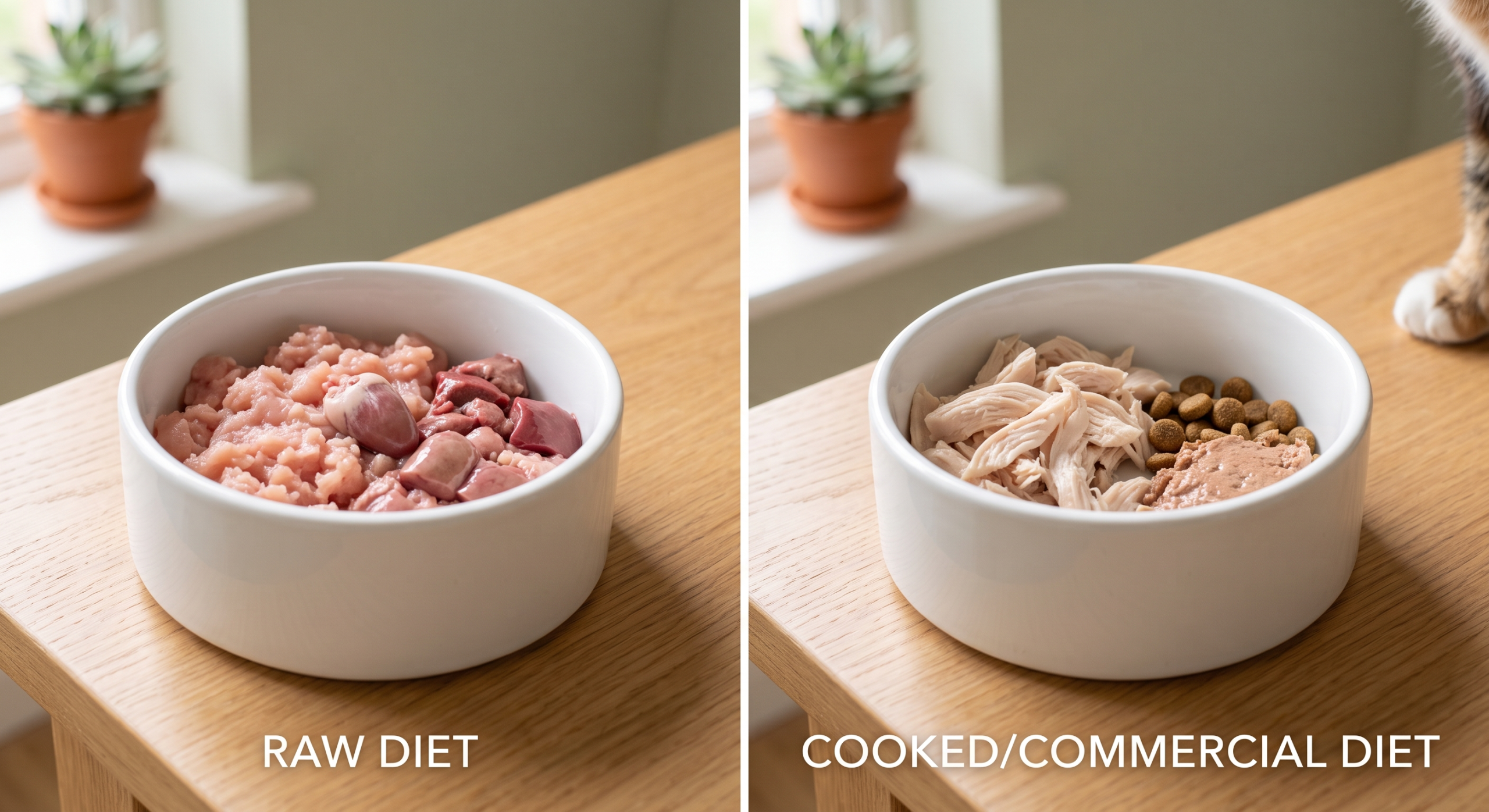
2. Overview: What Do "Raw" and "Cooked" Actually Mean?
Before we weigh the two sides of the Raw vs. Cooked Cat Food question, let's define each category clearly.
Raw cat food diets
Sometimes called BARF (Biologically Appropriate Raw Food) or RMBDs (Raw Meat-Based Diets), these are built around uncooked meat, organs, and sometimes bones. Common forms include:
- Fresh or frozen raw meat (ground or whole)
- Freeze-dried raw products
- Dehydrated raw formulas
- Homemade raw recipes from books or the internet
Cooked cat food diets
This is a much wider category:
- Commercial wet (canned) food
- Commercial dry food (kibble)
- Commercially prepared cooked fresh food (refrigerated pouches)
- Homemade cooked meals built with veterinary guidance
The real difference vets care about isn't just heat. It's whether the food is complete, balanced, and safety-tested before it reaches your cat's bowl. That's the heart of the Raw vs. Cooked Cat Food discussion.
3. Why Did Raw Feeding Become So Popular?
Raw feeding has grown steadily over the past two decades, driven by online communities, pet influencers, and a wider push toward "natural" living. A 2017 survey published in PeerJ found that 65% of cat owners were already familiar with raw meat diets, and most who fed raw got their information from the internet rather than their vet.
The appeal makes sense. Cats are obligate carnivores, so they rely entirely on nutrients from animal tissue. Wild cats eat prey raw. It feels logical that a house cat might do well on something similar.
Supporters point to shinier coats, better digestion, cleaner teeth, more energy, and even lower cancer risk. Those are appealing promises. But as you'll see, the evidence behind most of them just doesn't hold up, which is why the Raw vs. Cooked Cat Food debate needs a science-based view.
4. What Vets and Researchers Actually Found About Raw vs. Cooked Cat Food
The contamination problem is real
This is the part that's hard to wave away. A landmark FDA study from 2011–2012 screened over 1,000 pet food samples for disease-causing bacteria. The result: nearly 25% of raw food samples tested positive for harmful bacteria, including Salmonella and Listeria monocytogenes, according to VCA Animal Hospitals.
More recently, a September 2025 study in Communications Biology from Cornell University tested commercial raw cat foods sold in stores and online — including freeze-dried products many owners assume are safe. Researchers found multiple strains of Salmonella, Cronobacter, and E. coli. Even more worrying, they matched five Salmonella strains to human illness cases in a federal database, suggesting people were getting sick from the same products.
"Most of these products have no warning labels showing that the meat ingredients are not fully cooked," said Dr. Laura Goodman, lead researcher at Cornell's College of Veterinary Medicine. "Particularly for the freeze-dried products sold on shelves, consumers likely have no idea they are taking on that risk."
Other pathogens documented in raw pet food include Campylobacter, Clostridium species, Yersinia enterocolitica, antibiotic-resistant Pseudomonas, and parasites like Toxoplasma and Echinococcus. In the Raw vs. Cooked Cat Food discussion, this contamination risk is one of the strongest arguments against raw feeding.
The risk doesn't stay in the bowl
Raw-fed cats can shed dangerous bacteria through their saliva and feces, putting other pets and people at risk — even those who never touch the food. In July 2018, the CDC reported 90 people across 26 states infected with a linked strain of Salmonella traced to a commercial raw pet food. Two were children, and one developed osteomyelitis, a serious bone infection, according to a review in Today's Veterinary Nurse (November 2024).
Children, older adults, pregnant people, and anyone with a weakened immune system face the highest risk. That matters a lot in a busy household and makes the Raw vs. Cooked Cat Food choice even more important.
The claimed benefits are mostly unproven
Today's Veterinary Nurse put it plainly: "At this time, minimal evidence-based research supports the alleged benefits of feeding raw meat diets." The claims about glossy coats and better digestion are largely anecdotal and haven't held up in controlled studies.
The FDA, CDC, AVMA, AAHA, and the Canadian Veterinary Medical Association all officially advise against raw feeding for cats. That professional consensus shapes much of the Raw vs. Cooked Cat Food recommendation vets give in practice.
5. Common Myths About Raw vs. Cooked Cat Food — Debunked
Raw feeding advocates make some convincing-sounding claims. Here's what the science really says about the most common Raw vs. Cooked Cat Food myths.
Myth: Raw food preserves enzymes that cooking destroys
Your cat's gut and pancreas make all the enzymes needed for digestion. Any enzymes in raw meat are mostly broken down by stomach acid, not absorbed whole. There's no solid evidence that dietary enzymes from raw food help.
Myth: Cooking destroys essential nutrients
Manufacturers know cooking changes nutrient profiles, so they supplement accordingly. In some cases, cooking even makes certain nutrients easier to absorb. That's one reason a reputable cooked food often beats a homemade raw diet nutritionally.
Myth: Freezing raw food kills harmful bacteria
It doesn't. Salmonella and Listeria survive freezing and come right back once thawed. This one is especially dangerous because it gives owners false confidence.
Myth: Cats can "handle" bacteria from raw diets
Some cats seem fine, but that doesn't mean they aren't carrying and shedding pathogens. A healthy-looking cat can harbor Salmonella and Listeria while contaminating bowls, counters, and hands.
Myth: Raw diets match what cats eat in the wild
Wild cats do eat raw prey, but they also live shorter lives, face higher mortality, and don't share a home with toddlers or immune-compromised family. An indoor cat's needs and environment are simply different, which is another reason the Raw vs. Cooked Cat Food comparison matters in modern homes.
6. Nutritional Risks: It's Not Just About Bacteria
Beyond germs, raw and homemade cooked diets share another concern: nutritional imbalance.
Cats have very specific needs. Taurine — an amino acid from animal tissue — is essential for heart function and vision. Cats can't make enough on their own, so it has to come from food.
Here's a striking example: researchers fed cats whole ground rabbit, which technically had enough taurine. Yet several cats still developed taurine deficiency and heart disease. The taurine was present but not usable, meaning the cats couldn't absorb it well.
Many commercial raw diets lack an AAFCO (Association of American Feed Control Officials) nutritional adequacy statement, so there's no guarantee the food is complete and balanced. Homemade raw diets are especially risky unless a board-certified veterinary nutritionist designed them.
The same warning applies to homemade cooked food. Cooking for your cat can feel like an act of love, but without expert guidance, it's genuinely hard to hit every nutritional target over a lifetime. In Raw vs. Cooked Cat Food terms, nutritional reliability matters just as much as bacterial safety.
7. What Vets Recommend Instead: Choosing the Best Alternative
So if raw is off the table for most cats, what should you feed instead in the Raw vs. Cooked Cat Food choice? The good news is you have safe, vet-backed options.
Start with these three questions
- Is it complete and balanced? Look for the AAFCO statement (more on that below).
- Does it match my cat's life stage? Kittens, adults, and seniors have different needs.
- Does my vet approve it? Especially important if your cat has a health condition.
Wet vs. dry vs. fresh cooked
- Wet (canned) food — Great for hydration and picky eaters; often higher in protein.
- Dry (kibble) — Convenient, budget-friendly, easy to store; pair with a water bowl or fountain.
- Commercial fresh cooked — Balanced and gently cooked; usually pricier and needs refrigeration.
Any of these can be an excellent choice when it carries a proper AAFCO statement and suits your cat. Many owners do well mixing wet and dry. In most Raw vs. Cooked Cat Food comparisons, a balanced commercial cooked diet comes out ahead for practicality and safety.
8. How to Read a Cat Food Label
Whether you pick wet, dry, or fresh cooked, look for these on the label:
- ✅ AAFCO nutritional adequacy statement — Phrases like "complete and balanced for all life stages" or "formulated to meet AAFCO nutrient profiles"
- ✅ Named protein source — "Chicken," "salmon," or "turkey" rather than vague "meat by-products"
- ✅ Life-stage match — Kitten, adult, or senior
- ✅ Reputable manufacturer with real food-safety testing
- ✅ Vet approval — Especially for cats with health conditions

9. Feeding by Life Stage and Health Needs
Not every cat needs the same bowl. Here's how needs shift when choosing the right direction in Raw vs. Cooked Cat Food planning.
Kittens
Growing kittens need more calories, protein, and specific nutrients. Choose a food labeled for "growth" or "all life stages," and feed smaller, more frequent meals.
Adult cats
Most healthy adults do well on a balanced maintenance diet. Watch portions closely — indoor cats gain weight easily, and obesity is one of the most common feline health issues.
Senior cats
Older cats may need easier-to-digest food, joint support, or adjustments for kidney health. Ask your vet whether a senior-specific formula makes sense.
Cats with health conditions
Kidney disease, diabetes, allergies, and sensitive stomachs often call for a therapeutic or prescription diet. Never switch a medically managed cat's food without checking with your vet first.
10. How to Switch From Raw to Cooked Cat Food (Safely)
If you've decided the Raw vs. Cooked Cat Food question is settled for you — and you're ready to move your cat to cooked food — go slow. A sudden switch can upset their stomach, and cats can be famously stubborn eaters. Aim for a gradual transition over 7 to 10 days.
A simple day-by-day plan
- Days 1–2: 75% current food, 25% new cooked food
- Days 3–4: 50% current, 50% new
- Days 5–6: 25% current, 75% new
- Days 7–10: 100% new cooked food
Tips for a smooth transition
- Warm wet food slightly to boost aroma and tempt picky eaters
- Keep mealtimes and location consistent to lower stress
- Watch the litter box — loose stool or vomiting means slow down
- Be patient — some cats need the full 10 days or a little longer
- Call your vet if your cat refuses to eat for more than 24 hours, since cats shouldn't go long without food
Slowing down is almost always the fix if things get bumpy during a Raw vs. Cooked Cat Food transition.

11. If You Choose to Feed Raw Anyway
Some owners will stick with raw despite the risks. If that's you, vets ask that you at least follow strict hygiene, because the Raw vs. Cooked Cat Food risk gap is real:
- Tell your vet so they can care for your cat properly
- Wash hands thoroughly after every handling
- Use separate utensils, boards, and bowls just for raw prep
- Discard uneaten food quickly — bacteria multiply fast at room temperature
- Keep raw food frozen until use, then thaw in the fridge only
- Disinfect all surfaces and bowls after contact
- Keep kids, elderly, and immune-compromised family away from prep
- Ask about high-pressure processing (HPP) — it can reduce pathogens, though results vary
12. Safety First: What to Watch For
- ✅ Safe: Complete, balanced, AAFCO-labeled cooked food from a trusted brand; fresh water daily; portions matched to your cat's needs.
- ⚠️ Unsafe: Raw meat diets without safety testing; homemade meals without a nutritionist's recipe; feeding a medically managed cat the wrong food.
🚩 Warning signs — call your vet promptly if your cat shows:
- Repeated vomiting
- Bloody diarrhea
- Sudden lethargy or loss of appetite
- Fever or labored breathing
- Unexplained weight loss
Also contact your own doctor if anyone in the home develops signs of food poisoning after handling raw pet food or contact with your cat. This household risk is a major part of the Raw vs. Cooked Cat Food discussion.
13. Your Cat Food Checklist
Before you buy, run through this quick list:
- ☐ AAFCO "complete and balanced" statement present?
- ☐ Right for your cat's life stage (kitten, adult, senior)?
- ☐ Named protein source, not vague by-products?
- ☐ Made by a reputable, safety-testing brand?
- ☐ Any health conditions considered?
- ☐ Vet approved for your specific cat?
- ☐ Checked the FDA pet food recall database?
If you can tick every box, you're on solid ground when making a Raw vs. Cooked Cat Food choice.
14. Frequently Asked Questions
Do vets recommend raw diets for cats?
No. Major veterinary organizations — including the AVMA, AAHA, FDA, and CDC — advise against raw feeding for cats. The concerns are bacterial contamination, risk to people in the home, and a lack of proven benefit compared with cooked commercial food.
Is raw cat food healthier than wet or dry food?
There's no peer-reviewed evidence that raw is healthier than cooked commercial food. Claimed benefits like shinier coats or better digestion are anecdotal and haven't held up in controlled studies. A quality wet or dry food with an AAFCO statement is a safer, well-tested choice.
Can cats get sick from raw meat?
Yes. Raw cat food can carry Salmonella, Listeria monocytogenes, Campylobacter, E. coli, and Clostridium species. A 2025 Cornell study in Communications Biology even linked Salmonella strains in commercial raw cat food to confirmed human illnesses.
Can I make cooked cat food at home safely?
Homemade cooked food is safer than raw in terms of bacteria, but it risks nutritional gaps — especially taurine deficiency, which can cause heart and vision problems. Work with a board-certified veterinary nutritionist to build a recipe that's truly complete and balanced.
Does freeze-drying raw cat food make it safe?
No. Freeze-drying doesn't reliably kill bacteria. The 2025 Cornell study found pathogens in freeze-dried commercial cat foods sold on store shelves — products with no warning that the meat isn't fully cooked.
What is the safest diet for indoor cats?
For most indoor cats, the safest choice is a commercially prepared, cooked food with an AAFCO nutritional adequacy statement for their life stage. Both wet and dry foods from reputable brands qualify. Your vet can help fine-tune the pick for your cat's age and health.
15. The Bottom Line on Raw vs. Cooked Cat Food
The Raw vs. Cooked Cat Food debate isn't going away — the appeal is understandable, and the communities behind it are passionate. But the science is clear: raw diets carry documented, serious risks for both cats and the people who live with them, and the promised benefits haven't been proven.
That doesn't mean every food is equal. It means the safest foundation for your cat's bowl is a complete, balanced, commercially prepared cooked food — tested, regulated, and vet-approved. For most households, Raw vs. Cooked Cat Food is not a close call once safety and nutrition are weighed together.
Ready to Check Your Cat's Diet?
Here's your simple next step: check your current cat food label today. Look for that AAFCO statement, match it to your cat's life stage, and if anything's unclear, book a quick nutrition chat at your next vet visit. Ten minutes now can save you and your cat a lot of trouble later. You've got this.
⚠️ Disclaimer: This article is for informational purposes only and is not a substitute for professional veterinary advice, diagnosis, or treatment. Always consult a licensed veterinarian before changing your cat's diet, especially if your cat has an existing health condition.